
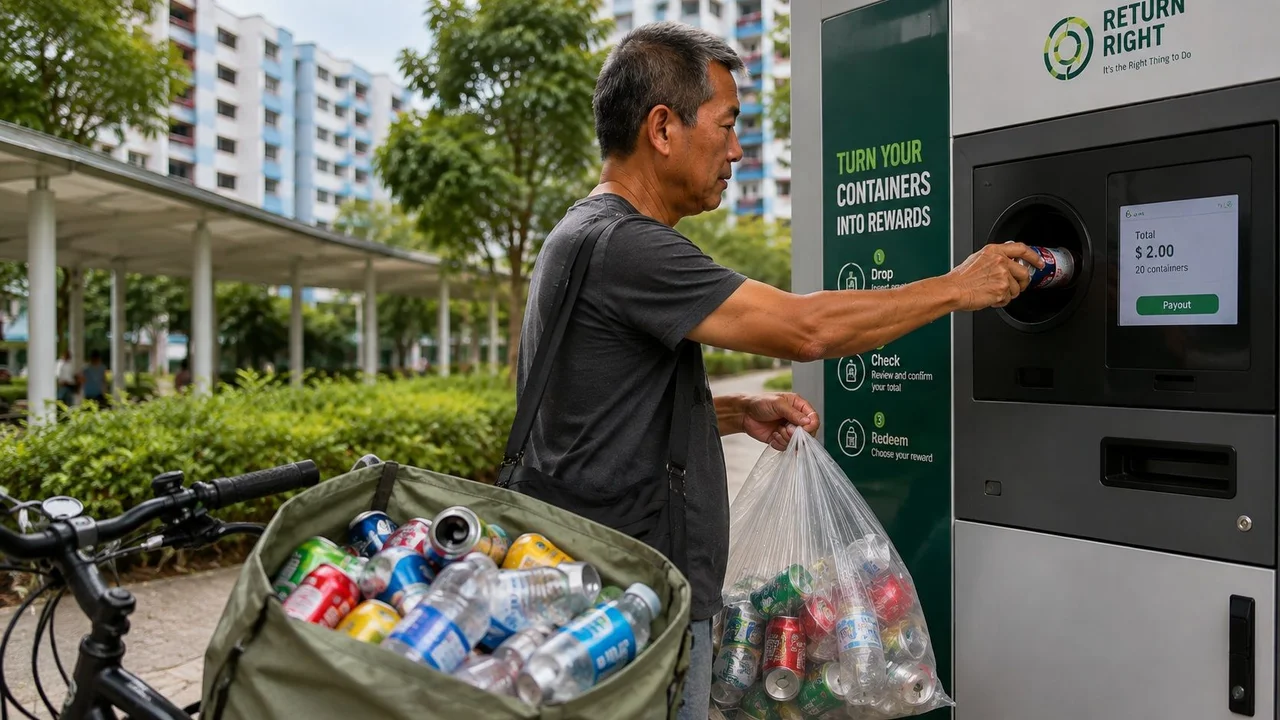
As the scheme was only introduced to the city-state this year, it has had some teething issues, including those concerning hygiene and sanitation.
“NEA says it’s too early to judge how well the scheme works, since it only fully kicked in on 1 Oct. But thinking about those who’ve had to queue behind a fellow neighbour(s) with a huge bag(s) of cans...or our schoolchildren who have no access to a machine in school, perhaps it’s more efficient for the F&B operators to centralise the collection, rather than the individual?” he asked.
Mr Chua’s question, however, involved the matter of how to return beverage containers when there are no reverse vending machines nearby, as well as cases of exemptions to the scheme, such as what occurred at the F1 Grand Prix.
He also asked if inclusion in the Return Right F&B Scheme for dine-in outlets would be extended to certain locations such as airport transit areas, given that travellers cannot get their deposit back.
He explained the Return Right F&B Scheme (RRFS), saying that he had visited an eatery in the Central Business District that handled the return for customers, as the 10-cent deposit would not be charged to people who consumed their drinks on the premises. They were just requested to leave the empty drink containers behind.
Mr Chua wrote in a recent social media post that he thought this was “an elegant way to encourage recycling without inconveniencing customers.”
Based on a written reply on Nov 4 from the Ministry of Sustainability and the Environment, the F1 attendees who bought drinks were not actually exempt from the scheme, as the organisers and F&B operators shouldered the deposit fees, and then placed receptacles within the venue for people to place their empty drink cans and bottles.
“That is the Return Right F&B Scheme at work,” wrote Mr Chua, adding that NEA is considering doing the same at other large events.
However, while almost 3,000 F&B establishments participate in the RRFS, with a total of 38,252 (as of end-2025) such outlets across Singapore, this number is still a minority.
The MP added that as RRFS only applies to dine-in cases, it still does not address the problem of buying a drink from a transit shop.
“When most coffee shops and hawker stalls don't collect cans, every single can ends up at a Return Right machine, one at a time.
The result? Queues behind someone feeding in a whole bag. Cans rejected. Refunds that never arrive,” he added.
He also noted that MSE had said it has no plans to put reverse vending machines in places such as school canteens and coffee shops, though officials will continue to monitor the issue.
Mr Chua therefore asked what students, who also pay the 10-cent deposit fee, should do with their drinks if there is no BCRS machine in their school. /TISG
Read also: ‘Deliberate manipulation of machines or fraudulent refund claims is taken seriously’ — BCRS operator warns after man’s alleged misuse of Return Right machine


