
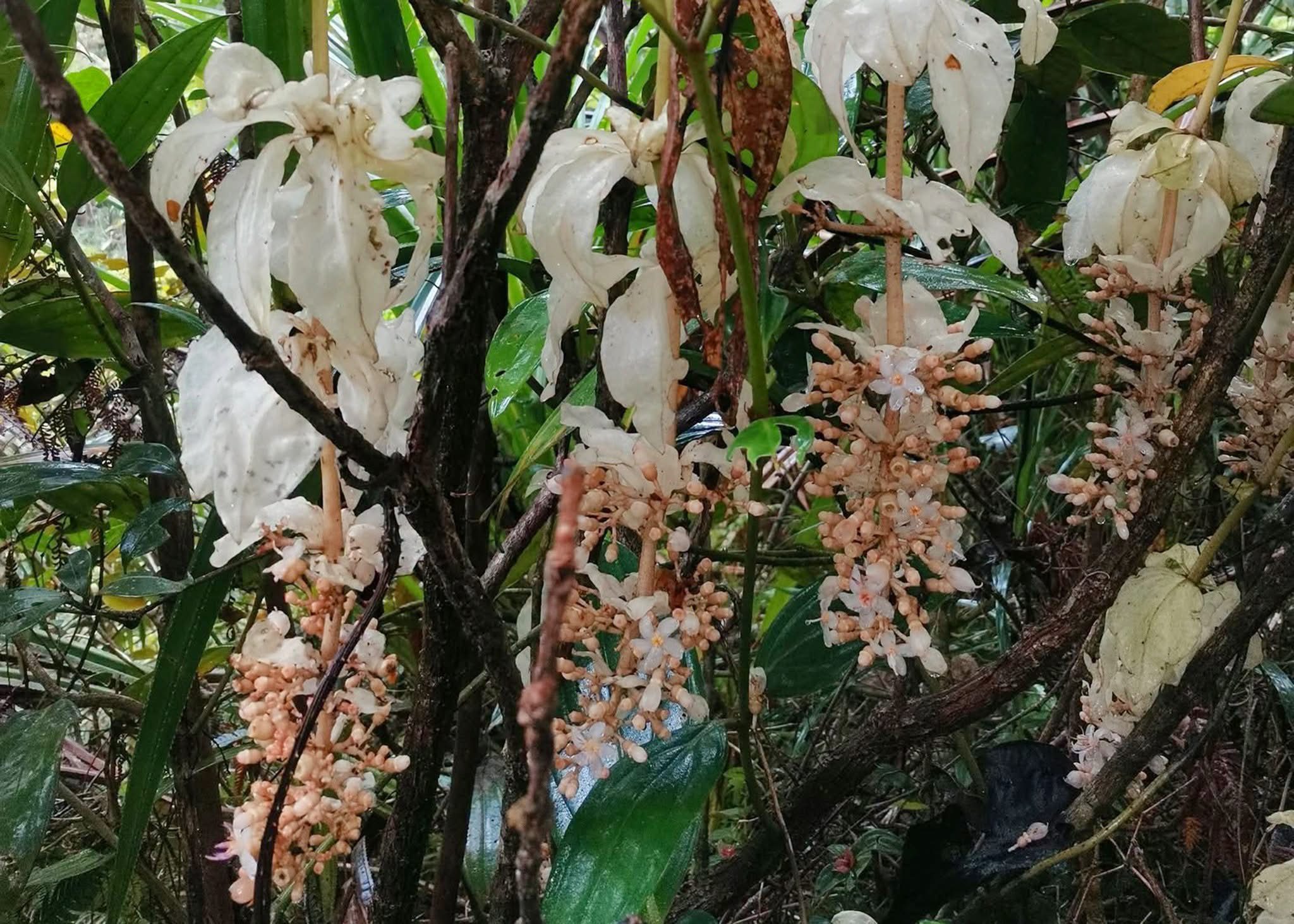
BAGUIO, Philippines – It was not hiding. In fact, the flowering plant is common in the forest where researchers found it. Yet botanists had overlooked it for centuries.
Now, a team of scientists has officially identified the plant as Medinilla bulutiorum, a species new to science from the forests of Calanasan, Apayao.
The “discovery,” published Wednesday, November 18, in the international scientific journal Phytotaxa, adds another species to the growing list of botanical finds from a province whose forests continue to reveal how much remains undocumented.
Researchers recorded the plant in Barangay Eva Puzon, where it grows in lower montane forests at elevations of approximately 700 to 900 meters.
The study was authored by Jiro T. Adorador, Zhereeleen D. Meneses-Adorador, Breiden Dela Cruz, Sarah Mae C. Batil, Jayson C. Ibañez, and J. Peter Quakenbush, who are affiliated with the University of the Philippines Los Baños, Apayao’s provincial and municipal environment offices, the Philippine Eagle Foundation, and Grand Valley State University in the United States.
The newly described species belongs to the Melastomataceae family, which includes the familiar ornamental Medinilla magnifica.
Both plants produce long, hanging flower clusters with prominent bracts, but M. bulutiorum differs in several characteristics, including its smaller leaves, rounded branchlets, more crowded flower clusters, and brownish covering on parts of its inflorescence.
Its identification marks at least the third plant species newly described from Calanasan since 2025.
In October 2025, scientists published Vaccinium kilangensis, a relative of blueberries collected near Kilang Pass along the Apayao–Ilocos Norte boundary.
Another species, Medinilla calanasan , first encountered in Barangay Eva, was formally described in February 2026.
Three species described in just over a year point to the scientific importance of Calanasan’s forests, where systematic botanical exploration has been limited.
The researchers themselves noted that M. bulutiorum had gone unnoticed by botanists despite being widespread at the site where it was documented.
The species was named in honor of the Bulut family, particularly the late Elias K. Bulut Sr., known as EKB, in recognition of the family’s leadership and stewardship of ancestral lands. Bulut is regarded as a founding political figure of Apayao.
Despite the discovery, scientists still know relatively little about the plant’s overall population and geographical distribution.
Researchers have provisionally assessed it as data deficient under the International Union for Conservation of Nature (IUCN) Red List criteria. The classification does not mean the species is endangered. It means available scientific information is insufficient to determine its extinction risk.
The discovery adds to the biological importance of the Apayaos Biosphere Reserve, which UNESCO recognized in July 2024.
Covering Apayao’s diverse landscapes, the reserve is internationally recognized for its biodiversity and efforts to balance conservation with the needs of local communities.
The latest findings also show why continued botanical surveys matter. Identifying a species allows researchers to study its distribution, assess potential threats, and determine what protection it may need.
For Calanasan, the succession of discoveries is more than a collection of new scientific names. It provides further evidence of the biological diversity of its forests and the importance of keeping those habitats intact.
Medinilla bulutiorum may have been familiar to people who have long lived near these forests. What is new is its formal recognition by science.
And with three species described from Calanasan since 2025, researchers have good reason to keep looking. – Rappler.com


