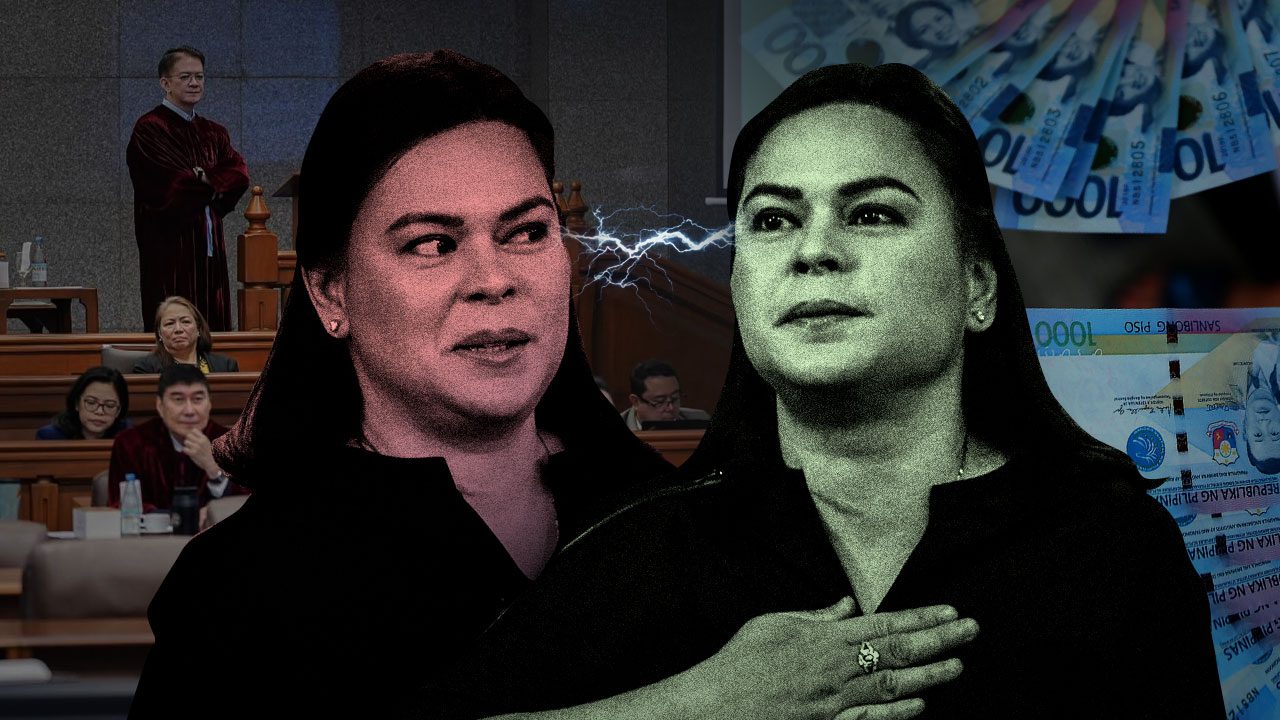
The public has waited a long time for Sara Duterte to answer questions about her and her family’s unexplained wealth. On Thursday morning, November 19, the 44th day of her impeachment trial, the defense appeared determined to answer anything but those questions.
What unfolded in the Senate impeachment court was less a demonstration of legal strategy than a spectacle of legal bewilderment.
It was like entering a cooking competition with an empty basket, an empty stove and absolutely nothing cooking, then spending the entire morning showing the judges photographs of meals prepared by other contestants. There was no food, no recipe, and no evidence that they had ever been near a kitchen.
Yet they had a slideshow. They had archival footage. They had pictures of famous chefs looking furious, other contestants crying, and somebody’s grandfather complaining about the previous cooking competition.
Meanwhile, the judges were still waiting for something edible. The contestant, apparently convinced that nostalgia is a culinary technique, kept serving up old photographs and wondering why nobody was impressed. At some point, this stops being a cooking competition and becomes an elaborate demonstration of how to avoid making dinner.
The question before the court is straightforward: Can Sara Duterte account for the wealth attributed to her and her family? At the center of that question are P319 million in foreign remittances allegedly received by Cale88 Foods Corporation, a firm partly owned by her husband. The Anti-Money Laundering Council has testified that the money came from China and Hong Kong. A financial forensic report, meanwhile, has raised questions about the company’s financial statements and whether its reported business activities can explain the movement of money through its accounts. These are specific claims that call for specific answers. The defense cannot make them disappear by discussing something else.
There are concrete allegations that call for concrete answers.
Instead, the defense chose to screen video clips of the late senator Miriam Defensor Santiago, the late former chief justice Renato Corona and Rodrigo Duterte, the vice president’s father and a detained former president.
One clip showed Santiago delivering a blistering lecture to prosecutors during Corona’s impeachment trial. Another featured Corona making an emotional appeal while fighting for his survival as chief justice. The third showed Rodrigo Duterte flatly rejecting suggestions that then vice president Leni Robredo should be impeached.
One might reasonably ask what any of this has to do with the allegations against Sara. The answer, so far, is nothing apparent.
Santiago’s eloquence won’t establish the legitimacy of Cale88’s transactions. Corona’s emotional distress won’t explain the company’s foreign remittances. And Rodrigo Duterte’s position about impeaching Robredo during his presidency won’t constitute evidence that his daughter can account for her wealth.
Not a film festival
An impeachment trial is not a film festival for recycled political grievances. Nor is it an exercise in nostalgia. Evidence is supposed to establish or challenge facts relevant to the charges. It is not supposed to provide a convenient occasion for playing old political footage and hoping that the emotional associations will do the work of an argument.
It is difficult to see why the serious questions surrounding Sara’s wealth should be displaced by video clips from entirely different impeachment proceedings, and her father’s pronouncements when he was president. That’s far out.
And what does this say about the lawyers entrusted with defending the vice president? Do they understand the case they are supposed to be answering? Do they appreciate that the impeachment court is not a stage for political theatrics, and that the reputation of a legal team rests on the quality of its arguments rather than the volume of its distractions?
There is something almost self-defeating about a defense that appears to mistake such antics for substance. Every irrelevant exhibit risks reminding the public of the very questions the lawyers and their client have yet to answer.
The defense may believe it is scoring political points. But a lawyer’s job is not to win a partisan audience. It is to confront the evidence.
For now, the defense seems to be laying an egg (read: “ nangingitlog ”). And the most damaging part may not be what they are failing to prove, but what they are revealing about their own approach to the trial.
The vice president was brought to the impeachment court with allegations of unexplained wealth hanging over her. The public is entitled to expect answers. So far, she has offered none except a collection of old political grievances from another time, a few familiar faces from impeachment history and a defense that seems to have forgotten what game it is playing.
She was quoted by TV5 News on Wednesday, November 18, as saying that corruption “is a progressive disorder that has embedded itself deep within the DNA of the government – and tragically, it is the Filipino people who are left to suffer the consequences.” She urged the public to demand accountability.
I couldn’t agree more. But accountability cannot be a slogan reserved only for one’s political enemies. It must apply even to those who preach against corruption while facing serious questions about their own wealth. Sara cannot demand that the Filipino people hold others accountable while refusing to give them straight answers herself. If accountability means anything, it must begin at home.
And that is precisely why Vice President Sara Duterte needs to go. Pastilan. – Rappler.com
[Pastilan] Sara wants to answer? Start with the wealth
[Pastilan] The Davao lies are having a meeting