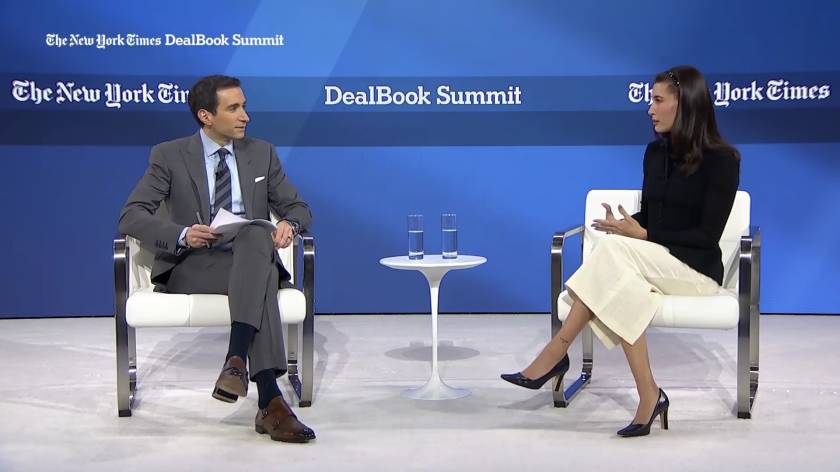
A controversial New York Times interview of Rhode founder Hailey Bieber has ignited fierce debate over how founders should communicate after securing a billion-dollar buyout deal.
But instead of joining a social media pile-on, some founders say the criticism is misplaced — and the interview missed what really makes Bieber and the business tick.
Related Article Block Placeholder Article ID: 331549
Rhode didn’t just launch in Australia — it engineered a cultural moment
“I think we have an outdated definition, firstly, of what commercial intelligence actually is,” said Tracey Warren, CEO of F5 Collective.
“And I think it was a missed opportunity on the interviewer’s part to not actually have some commercial curiosity and unpack the answers that she did give.”
‘Optimistical’ claims
The debate stems from an interview Bieber gave to Andrew Ross Sorkin at the paper’s DealBook summit, discussing her beauty brand and its stratospheric success.
Smarter business news. Straight to your inbox.
For startup founders, small businesses and leaders. Build sharper instincts and better strategy by learning from Australia’s smartest business minds. Sign up for free.
By continuing, you agree to our Terms & Conditions and Privacy Policy .
The conversation was framed around Rhode’s rapid growth and resonance in a crowded skincare market, which ultimately earned the brand a buyout worth up to US$1 billion ($1.5 billion) last year.
But Sorkin’s line of questioning, and the depth of Bieber’s specific responses, have captured more attention than the business story itself.
At the outset, Sorkin asked Bieber why, upon founding the business in 2022, she decided not to part ways with the business for less than ten figures.
“From the get-go, you said a billion dollars. Why did you think that you could do?” asked Sorkin.
“You have to have a certain sense of ‘optimistical’ delusion,” said Bieber.
The conversation did not dwell on the deal itself, avoiding a nitty-gritty conversation about its structure and Rhode’s financial performance.
Instead, Sorkin and Bieber discussed how Rhode, under new owners E.L.F Beauty, might continue the brand when she is no longer its public face.
“I hope that as that happens, and when it happens, the brand can really stand strong on its own,” she said.
The conversation also touched on social media addiction, the perils of personal comparison, and ways to navigate public scrutiny as a high-profile founder.
Bieber faces criticism
Since the interview, Bieber has faced criticism for what some viewers described as shallow answers to Sorkin’s questions, in a live forum that also hosted Sam Altman, Elon Musk, and Microsoft CEO Satya Nadella.
“I had harder questions during job interviews than this,” said one LinkedIn commenter , implying Sorkin softened his line of questioning to accommodate Bieber’s responses.
“Shouldn’t you be able to simplify complex things, into a one comprehensive thought? Shouldn’t you be treated as a guest of a serious weight, [and] therefore, receive questions that respond to that expectation?”
“It’s just crazy how someone can build a company that was sold for $1 billion and still struggle to answer basic questions about her own business,” wrote a Reddit user.
Related Article Block Placeholder Article ID: 331595
Aussie brand Dr Diamond goes viral after gifting jewellery pen to Rhode’s Hailey Bieber
“She wasn’t actually at the negotiating table, right?”
Similar comments abound across social media, questioning everything from Bieber’s business acumen to her use of the word ‘optimistical’.
Notably, the New York Times has turned off the YouTube comment section for its video — while its interview of Musk, inarguably a more controversial figure, still has live comments.
Did the interview miss the point?
Speaking to SmartCompany, F5 Collective’s Tracey Warren said some of the criticism fundamentally misunderstands the tangible value and entrepreneurial skills Bieber brings to the Rhode brand.
“I actually think everyone is having the wrong conversation about Hailey Bieber, and it’s not just a story about celebrity, or privilege, or confidence, or lack of knowledge,” she said.
“It is absolutely fine to walk in with really heavy hitting commercial questions around a billion dollar sale,” she continued.
“I totally get that. But I think fluency in business terminology is absolutely not the same thing as commercial intelligence.”
Relying too hard on financial jargon can signal “performative entrepreneurship”, she added.
Warren, whose F5 Collective provides capital to women-led businesses, said conflating technical terminology with actual business nous is a grave error.
“I work with and meet so many founders that can articulate their TAM, SAM, and SOM, but they cannot explain to me why a customer would fall in love with their product,” she said.
“And if you take Hailey Bieber, she can absolutely articulate to you why a customer would fall in love with her product and that brand world.”
SKU’d perspectives
Others have echoed Warren’s view, and highlighted the value a founder like Bieber can bring to an aspirational business.
“Building a valuable business and explaining it under pressure are two different skills, and both are worth getting right,” wrote Sarah Petty, founder of Melbourne’s Olive Business Partners.
“At the end of the day, all founders need a little ‘optimistical delusion’”.
“The self-belief, the big number she says she would not go below, the dream-big story: that is what Rhode sells,” wrote US marketing commentator Nini Dumont.
“It is how 10 products reached $212 million ($322 million) in yearly sales before the deal. A polished answer about distribution would not have sold one more lip treatment.”
Dumont also focused on Bieber’s job title under Rhode’s E.L.F ownership — chief creative officer and head of innovation — suggesting the answers she gave were appropriate for her roles.
Fans challenge personal questions
Later, Sorkin’s line of questioning about competing celebrity-founded brands frustrated some Bieber supporters.
Sorkin referenced a prior podcast appearance in which Bieber said she “didn’t want to be here any more”.
Bieber discussed a period where verbal abuse was levelled at her online and in person, and examples where “people were putting tip jars up in Starbucks, of me versus this person, versus this person.”
Towards the end of the interview, Sorkin posed a question: out of the celebrity-founded brands SKIMS , Rare Beauty, and Fenty, which would she most like Rhode to acquire?
Bieber picked Kim Kardashian’s SKIMS, side-stepping Rare Beauty, which was founded by Selena Gomez — her husband Justin Bieber’s ex-partner, and the other name on the tip jars Bieber mentioned earlier.
Related Article Block Placeholder Article ID: 348690
Kim Kardashian’s SKIMS under fire for “terrible” $216 advent calendar
Discussing the interview on Reddit, some commenters said the oblique Gomez reference was inappropriate.
“I think the rare beauty thing towards the end was a bit mean, but that’s the only thing I can flag,” wrote a fan.
There was “absolutely no need to ask the rare beauty question, they knew what they were doing,” wrote another.
“Extremely disrespectful and unprofessional.”
Others had a slightly different view, arguing uncomfortable questions are fine in the context of an interview with the New York Times .
“Am I the only one that thinks yes, mentioning Rare Beauty might’ve been a bit touchy, but also it’s a competitor within the same space?” said another fan on Reddit.
“I completely understand how it might’ve been in poor taste, but it is one of the only (also) successful celebrity make up brands.”
Bieber did touch on Rhode’s relative restraint compared to other beauty and skincare brands flooding the market with new SKUs.
But Warren said Sorkin could have dug deeper on that line of questioning, which may have showcased the discretion and taste that propelled Rhode to global heights.
“She probably could have articulated these things a little better… But I don’t know why we should hold her to that, right?” said Warren, given the interview’s nature.
Bieber herself appears to have responded to some of the criticism, posting a Google screenshot confirming “optimistical” as a variation of “optimistic”.
“Anyways…” she wrote on social media.
Never miss a story: sign up to SmartCompany’s free daily newsletter and find our best stories on LinkedIn .
Senior Business Journalist
Focused on the small business sector, David’s work covers the political, regulatory, and economic issues facing Australian entrepreneurs. Prior to joining SmartCompany, he was a reporter for Business Insider Australia. You can follow him on LinkedIn.
Recommended for you
Eloise Keating Feb 17, 2026
Inside the ‘influencer Olympics’: What Coachella tells brands about gen Z
Trent Rigby Apr 14, 2026
Jessica Robinson Feb 16, 2026
Reed Retail Fairs Sydney – the launchpad for what’s next in Australian retail.