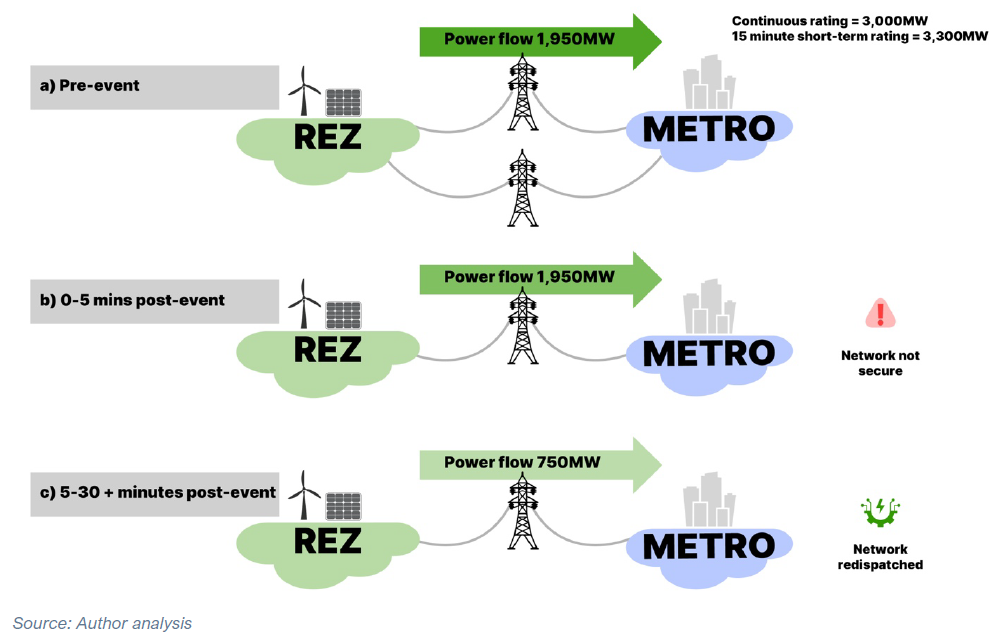
A new report from the Institute for Energy Economics and Financial Analysis (IEEFA) shows coordinated multiple battery reserves could unlock underutilised transmission capacity, saying a flexible battery energy storage (BESS)-system integrity protection scheme (SIPS) portfolio can build on existing big battery support of transmission networks.
Designed to meet the increased uptake in consumer electrification and data centre connections, the report says a Flexible BESS-SIPS Portfolio could have the potential to keep pace with increasing renewable energy connections to the National Electricity Market (NEM), which currently outpace transmission projects by up to eight years.
The IEEFA ‘Dynamic battery reserves can deliver network benefits’ Report Author and Engineer Dr Sarah Probert says that while new generation and load connections have delivery timeframes typically of two to three years, transmission projects are much longer.
“The sequencing gap between connections and transmission development increases the risk of energy supply limitations and high electricity prices arising from insufficient transmission capacity,” Probert says in the report.
Highlighting the Victorian Big Battery and Waratah Super Battery transmission supports under existing SIPS contracts, and the Waratah contract being more flexible to improve utilisation, the report recommends a broader Flexible BESS–SIPS Portfolio to extend these services.
Coordinating multiple batteries across corridors could provide rapid fault response, slow resecuring support, or both, and enable transmission lines to run at higher levels, unlocking more renewable energy from renewable energy zones (REZs).
Probert recommends the concept be tested through modelling and a system trial that tests feasibility, costs, battery locations, transfer uplift, and the frequency and duration of reserve needs.
The initial procurement could use tenders or existing network and transitional-service contracts, with a dedicated mechanism for later consideration, Probert recommends.
Probert says a new System Operator function should be established to co-ordinate the Flexible BESS– SIPS Portfolio.
The System Operator could identify when additional reserves are required, particularly during periods of high REZ generation, high demand or planned outages, and optimise the quantity and type of reserve response from any participating BESS.
“This function would support greater utilisation of existing transmission infrastructure and facilitate higher levels of renewable energy transfer,” Probert says.
“The Australian Energy Market Commission (AEMC) should consider the benefits of standalone BESS and hybrid systems delivering a Flexible BESS–SIPS Portfolio response to increase network capacity as part of its Electricity Network Regulation Review.”