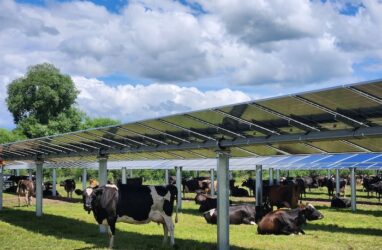
The owner of a small solar farm in central New Zealand has discovered that raising solar modules high enough to allow cows to graze underneath is cheaper than thought, and the engineer behind the final design says that it may be cheaper still for Australian installations.
The 4.7 megawatt (MW) Gordon solar farm, in Galatea about 50km south east of Rotorua in the North Island, officially opened earlier this month after a seven-year odyssey from idea to launch.
The final costs for a raised solar system that cattle can comfortably fit under is one of its biggest outcomes, with the cost of making and delivering the 2.2m tall solar tracker systems coming in at only 10 per cent more than a standard 1.6m version, according Clenergy head of utility projects Yuneska Harris.
The 3.3m foundations were 47 per cent more expensive than standard versions, but that is because they had to factor NZ’s unique geology, including the nearby Waiohau faultline, loose volcanic soils, and the medium-high risk of liquefaction when an earthquake turns the ground to an almost-liquid mush.
Harris’ research into New Zealand’s other cattle-under-solar project in Waiuku, a 2.4 MW installation, and the 60 kilowatt prototype built at the Farrer Memorial agricultural high school in New South Wales (NSW), led her to believe the cost to build the structure would be at least 160 per cent more than a standard tracker.
Instead, it worked out to be 57 per cent more in total manufacturing costs.
“From a manufacturing point of view it only cost less than 10 per cent more [to make the] above ground [structures]. Below ground, that was driven by soil conditions and the landscape in New Zealand,” Harris told Renew Economy .
“If we install exactly the same system in more standard condition soil, probably the foundations won’t cost as much, maybe a 20 per cent, 15 per cent difference to standard foundations.
“But what I want to highlight is everyone thinks that increasing the clearance to allow grazing is going to be way too expensive [and it’s not].”
Harris’ point is that Australian soils may be able to get away with shallower and lower cost foundations than the maximum challenge posed by engineering for a seismic zone in New Zealand.
This cost doesn’t include installation, however, which was initially delayed as the team struggled to find an inefficient way to work at the 2.2m height.
That problem was solved with shoe risers used in orchards, allowing the installers to claw back enough time to finish two weeks early.
Electricity as important as farming
After years of being written off as too expensive and too difficult, putting cattle under solar panels is attracting real attention.
A German company introduced its Europe-tested system to Australia last month and an Australian startup is also preparing to test its cow-friendly model in NSW ahead of commercial sales.
Both say they see real interest from landowners in solar that prioritises agricultural needs alongside electricity generation.
It remains to be seen whether large scale developers’ interest might be piqued, as a way to calm community nervousness around solar projects moving into more fertile farming areas.
The Gordon system is tailored to the dairy farm’s needs: the panels lie flat during the night when some 700 cattle are in the paddocks.
The maximum tilt leads to a ground clearance of 1.1m, but the cows are moved for milking before sunrise and are elsewhere during the day when the panels tilt to catch the sun.
There is a plan, however, to switch to horizontal mode during summer and let the animals back in for the shade.
The 10 hectare project was driven by farm owners Susan and Rory Gordon and Gerrard McCarthy from Micropico Systems, who specialises in putting renewable energy on farms.
Harris was brought in later, after a gruelling five years of planning, consultation and permit paperwork, to design a tracker system around the farm needs, rather than optimising electricity production.
“It took us six designs to find [that 2.2m] is the sweet spot for the clearance that won’t impact the structure,” she says, although she admits she was sceptical.
“I was one of the first ones to say no, let’s just decrease the clearance, this is too complicated from an engineering point of view.”
But ultimately she says the only difference was the clearance and all other factors remain the same, from the cabling to the solar panels themselves.
To support independent media, and help combat the spread of deliberate misinformation and disinformation about the energy transition, you can click here to make a one off donation or become a regular supporter of Renew Economy.
To join more than 29,000 others and get the latest clean energy news delivered straight to your inbox, for free, click here to subscribe to our free daily newsletter .
Rachel Williamson is a science and business journalist, who focuses on climate change-related health and environmental issues.
Share on Facebook (Opens in new window) Facebook
Share on X (Opens in new window) X
Share on LinkedIn (Opens in new window) LinkedIn
Share on Reddit (Opens in new window) Reddit
Email a link to a friend (Opens in new window) Email
Print (Opens in new window) Print
agrisolar , Featured , New Zealand
Another heavily curtailed solar farm seeks approval to add a big battery
Another solar farm that suffers from heavy curtailment – both from network constraints and low prices – is seeking planning and environmental approvals to add a big battery to the project to allow it to store power for when it is needed more. There are now virtually no solar farms being built in Australia without…
Massive new solar farm and battery hybrid joins rush to connect to major new transmission line
Another major new solar farm and battery hybrid project seeks approvals as it joins queue to connect to major new transmission project outside of an REZ.
Raising solar farm modules high enough to allow cows to graze below turns out to be cheaper than thought
A pioneering solar farm has discovered that having modules installed high enough to allow cows not graze underneath is less costly than thought.
Records tumble for big and small renewables, as doubling of new big batteries helps slash cost of power
New data shows that for all of the failed COP pledges, renewables are edging out fossil fuels at a record rate and batteries are crushing power prices.
Join our WhatsApp Channel
I allow to create an account
When you login first time using a Social Login button, we collect your account public profile information shared by Social Login provider, based on your privacy settings. We also get your email address to automatically create an account for you in our website. Once your account is created, you’ll be logged-in to this account.
Please login or register to comment
Plan to build big battery in ex-premier’s home town will have to dodge abandoned gold mine shafts
Coal power offers “no chance to compete,” says Rio Tinto, as smelters go all-in on renewables
“Deniers and delayers:” Bowen marks 600,000 cheaper home batteries, but says balcony solar cannot be rushed
State adds $4,000 “discount” to energy upgrade scheme, targeting low-income households and renters
“Unbankable:” Fresh blow to Beetaloo as last of Big Four banks rules out finance for new gas pipelines
Can solar, batteries, EVs and home appliances all work together? Only if they learn how to connect
Chris Briggs, Ed Langham & Matt Daly
SwitchedOn podcast: Australia needs to quadruple its efforts to meet COP31 electrification pledge
The fossil fuel-backed IPA’s deep connections with likely new Liberal premier