
Commodity traders and smaller investment firms are racing to secure Venezuela’s mineral assets following the US capture of former president Nicolás Maduro in January , while major miners remain wary of committing capital to the country.
Mercuria, Trafigura, Glencore (LON: GLEN) and US investment firm Heeney Capital are among the companies pursuing opportunities under a new mining law and sanctions relief granted by the US Treasury’s Office of Foreign Assets Control (OFAC). Their interest centres on rehabilitating state-owned operations and securing long-term supply agreements.
“The interest from commodity traders and smaller investors reflects the possibility of securing access to assets or future supply at a stage when competition is still limited,” mining consultancy Plusmining told MINING.COM.
The emerging deals could help reverse decades of underinvestment in Venezuela’s mining industry and diversify an economy heavily dependent on oil. Hydrocarbons accounted for 97.1% of the $15.6 billion the government reported from its oil and mining sectors between January and November 2026.
For commodity traders, the ability to commit capital gradually offers an advantage over traditional mining companies, which must weigh multibillion-dollar developments against investment opportunities in more established jurisdictions.
“Traders can secure offtake, finance shipments and commit capital in stages. A major miner has to make a different decision,” Juan Ignacio Guzmán, CEO of GEM Mining Consulting, told MINING.COM. “It has to put substantial capital into assets that will stay in Venezuela for decades and compete for that capital against projects elsewhere in its portfolio.”
Venezuela enacted a new Organic Law of Mines on April 16, retaining state ownership of mineral deposits while allowing private concessions of up to 30 years, with possible extensions. The legislation follows a similar overhaul of the hydrocarbons sector .
The reforms dismantle restrictions imposed under former president Hugo Chávez, whose nationalization policies triggered more than a dozen international arbitration claims, many still unresolved. Venezuela nationalized its gold industry in 2011.
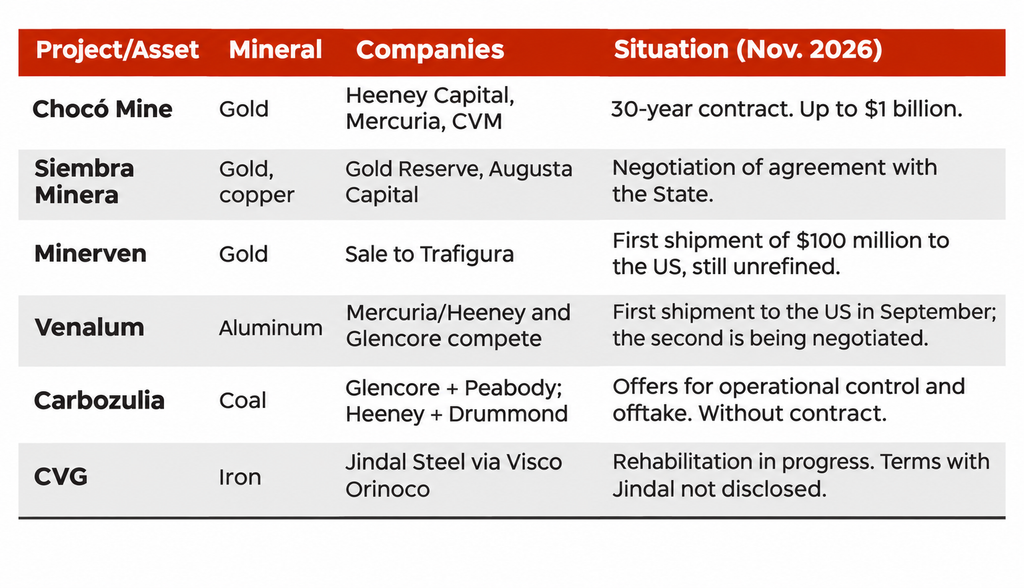
The most advanced agreement involves the Chocó gold mine in El Callao, Bolívar state, where Heeney Capital and Mercuria signed a 30-year contract in September with state-owned Corporación Venezolana de Minería (CVM), involving an initial investment of up to $1 billion.
Regulatory restrictions complicate the project’s development. OFAC licence 51D permits trading and refining Venezuelan gold but not extraction, while licence 55A authorizes contract negotiations subject to Washington’s approval.
“For transactions subject to the US Treasury’s contingent investment licensing framework, the ability to sign an agreement does not by itself authorize the investment to proceed,” Plusmining said.
Even gold exports face hurdles. A first shipment to the US , valued at about $100 million and handled by Trafigura, remains in storage after American refiners demanded proof of origin for material supplied by state producer Minerven.
Another potential transaction centres on Siembra Minera, one of Venezuela’s largest undeveloped mineral assets, with historical resources of nearly 52 million oz. of gold and 5 billion lb. of copper. Gold Reserve (TSX-V: GRZ), which holds a 45% interest in the project, is negotiating with the government alongside Augusta Capital, which could invest up to $200 million to acquire half of that stake.
Competition extends beyond precious metals. State-owned aluminum producer Venalum shipped about 15,000 tonnes to the US in September. Mercuria and Heeney are competing with Glencore to operate the smelter, which has annual capacity of about 430,000 tonnes and depends on restarting bauxite mining at Los Pijiguaos.
In western Zulia state, Glencore and Peabody Energy (NYSE: BTU) are considering a joint bid for coal assets , while Heeney is pursuing a separate proposal with Alabama-based Drummond.
The target is state coal company Carbozulia, whose annual production fell to about 350,000 tonnes in 2024 from 8.7 million tonnes in 2000.
Beyond the contracts
Interim President Delcy Rodríguez appointed a commission in April to audit and classify state assets across the energy, power and mining industries for potential transfer to private investors or former owners. She reported progress in October , although the list of available assets remains pending.
For major miners, enforceable mining titles, resolution of legacy claims, predictable taxation and the ability to repatriate earnings will be essential, Guzmán said. Companies will also require independently verified reserves, reliable infrastructure, sanctions authorizations acceptable to banks and insurers, and credible protections for local and Indigenous communities.
Political developments in Caracas and Washington could complicate those decisions. European Union sanctions against Rodríguez are due to expire Jan. 10 2027, while Venezuela could hold presidential elections in 2027 or 2028.
Guzmán expects coming events to favour existing gold, iron ore, bauxite and aluminum operations over capital-intensive greenfield developments. Some early agreements could prove commercially attractive without materially increasing domestic production.
“My base case is that trade recovers first, a few viable operations restart, and large new mines take considerably longer,” Guzmán said.
The distinction between individual mine restarts and an industry-wide recovery will become increasingly important as investors assess Venezuela against competing mining jurisdictions.
“The stronger evidence of a broader and sustained revival would be several projects obtaining the necessary approvals, securing financing and putting capital to work on site, followed by measurable increases in production,” Plusmining said.

