The New Zealand residential solar market operates quite differently to its Australian counterpart. Kiwi homeowners get no upfront solar subsidy, no battery rebate, and no net metering. Energy retailers pay for exports, but the economics are built around using your own solar generation.
The NZ solar industry had to make the numbers stack up without much help from the government. That’s made growth frustratingly slow at times, but steadier, without the booms and busts that come with incentives being switched on and off.
The biggest helping hand has come from the big banks, with mortgage top-ups for solar and batteries at 1% for three years or 0% for five years. They’ve been a key growth driver for years. Long may they last, but banks can pull them at any time.
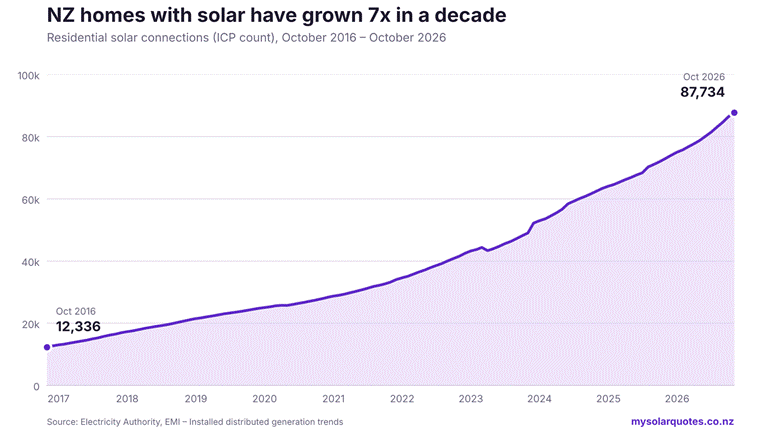
Even so, the market is on a growth curve.
2026 at a glance ( January to mid-November)
13,282 new residential solar installations, already more than all of 2025.
87,734 homes with solar (4.3% of homes), totalling 523 MW.
8.7 kW – the average new residential system size, up from 3.3 kW a decade ago.
$2.04 per watt average price for solar, the same as 2025.
About half of new home systems include a battery: 48% in our survey, around 53% in Electricity Authority data.
$33,000 average for a solar and battery package.
The fuel shock brought buyers forward
The war in Iran landed in a country already thinking harder about resilience after several years of severe weather events. Then fuel prices jumped, and energy security suddenly had a very visible price tag.
Some households responded by buying an EV. Once your transport runs off your power bill, solar is a natural next step. Making fuel on your own roof has an obvious appeal to the Kiwi instinct for looking after yourself.
At My Solar Quotes, we saw our biggest ever surge in enquiries. Installers told me the same, with some booked six to eight months ahead.
That urgency eased as expensive fuel became part of the household budget. The vulnerabilities hadn’t gone away; people just got used to them.
I see that surge as households bringing forward decisions they were already considering. The fuel shock supplied the urgency. Electricity prices supplied the ongoing reason.
The real driver: climbing power bills
The average annual household electricity bill is now about NZD 2,617 (2,151). Average electricity costs have risen 46% in a decade, reaching 42.1 cents per kWh.
Network investment is adding to the squeeze as lines companies renew ageing infrastructure and expand capacity for electrification. Meanwhile, the average fixed charge of NZD 2.70 a day costs households nearly NZD 990 a year before they use a single unit of electricity. Households can improve their energy efficiency and still find themselves paying more.
Solar lets Kiwis buy less power from the grid and earn a bit of cheddar by selling their surplus back.
Geopolitics triggered a rush of buyers earlier this year, but rising power prices remain the market’s most consistent driver. With the cost of living front of mind for voters, they also gave politicians an obvious place to start making promises.
Then the politicians brought out the carrots
Ahead of the 7 November election, solar became a prominent political offering . Promises ranged from cheaper, more accessible finance to Labour’s subsidy offer of up to NZD 3,000 for low- and middle-income households.
After years of governments leaving residential solar to its own devices, it was quite something to see everyone arrive with a carrot.
For some households, though, the response was to wait. Enquiries have been noticeably quieter for the past few months as buyers wait to see which promises become policy. Elections make buyers cautious anyway; the prospect of financial help gives them another reason to sit tight.
For installers carrying months of booked work, that pause has provided a useful breather.
I’m skeptical that a government-backed loan will move the needle much for households already eligible for cheap bank finance. The bigger opportunity is reaching those who currently miss out. Longer repayment terms could help too, but the fine print will determine how far these schemes actually widen access. Who qualifies, and on what terms, is what I’ll be watching.
Bigger systems, same price
Solar prices held steady during 2025 at NZD 2 per watt , unchanged from 2025. That’s despite higher panel costs after China scrapped its export tax rebate in April, freight rates more than doubling and a weaker Kiwi dollar.
But that steady average hides a small price rise. Like-for-like prices crept up a few percent across most system sizes. Kiwis are simply installing bigger systems, which cost less per watt and kept the overall average flat.
That shift is a long-running trend. The average new home system has more than doubled in a decade, from around 3.3 kW to close to 9 kW. The last two years have been the fastest yet, with the average climbing more than a kW a year, from 6.4 kW in 2024 to 7.6 kW in 2025 and 8.7 kW this year. Cheap panels, batteries and low-interest bank loans all made it easy to fill the roof.
Half of buyers now add a battery – with no rebate
The most interesting change is batteries. Australia needed a federal rebate to get home batteries moving. New Zealand has nothing, yet about half of new home solar systems now include one , up from about 29% in 2024.
I’ve had people tell me, “Solar doesn’t really work without a battery.” Yeah, nah. It absolutely does. But somewhere along the way, Kiwis seem to have convinced themselves the two have to come as a package.
Median payback is seven years for solar only and nine years with a battery.
Battery buyers tell us the main reason is to use more of their own solar, followed by backup during blackouts.
Tesla Powerwall 3 and Sigenergy made up more than 70% of the batteries in our survey, and battery buyers also go bigger on solar, averaging 10.1 kW compared with 8.1 kW for solar-only homes.
Our batteries are still small by Australian standards, though. The average Kiwi battery in our survey was 11.5 kWh, and the most common size was 13.5 kWh, roughly half the Australian average of about 22 kWh. Without a rebate, upfront cost is what stops many from going bigger.
Solar power system installed in Hawke’s Bay by Ecoefficient
Where to from here?
New Zealand is past the early adopter stage – a long haul, but we got there. Solar is becoming normal, and we may be at the start of an exponential curve. A typical solar and battery system costs NZD 30,000 to NZD 35,000, but most buyers can justify it to bring down their power bills.
There is plenty of room to grow. Roughly one in 25 Kiwi homes has solar, compared with more than 30% of Australian households.
The risks are the ones you’d expect: cheap bank finance could disappear, and a sudden surge in demand could stretch installers and invite poor workmanship. Government incentives could be a positive or equally a hindrance – yet to be seen.
But if this year has shown anything, it’s that New Zealanders don’t need a rebate to go solar. They need high power bills, affordable finance and confidence that the numbers stack up. Right now, they have all three.
Author: Kristy Hoare, founder, Mysolarquotes.co.nz