
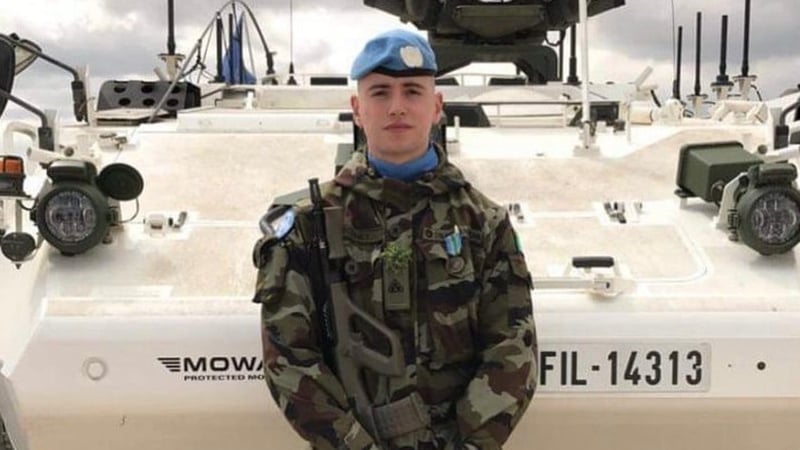
An inquest into the fatal shooting of Private Seán Rooney has heard he might have already been dead by the time the Defence Forces tactical operations centre was notified his two-vehicle convoy had become separated.
The fourth day of the inquest heard evidence that the separation of the convoy may not have been notified to the headquarters of the Irish peacekeeping troops in Lebanon for at least 30 minutes after soldiers in it became aware they were no longer travelling together.
Pte Rooney, from Newtowncunningham in Co Donegal, suffered fatal gunshot wounds in an attack which took place near the Lebanese village of Aaqbiyeh, after the military jeep he was driving became separated from the lead vehicle on 14 December 2022.
The 24-year-old, who was attached to the 27th Infantry Battalion at Aiken Barracks in Dundalk, Co Louth, was driving a UN-marked vehicle which was fired on by armed militia linked to Hezbollah while they were trying to escape from a group of locals who had surrounded the jeep in Aaqbiyeh.
The convoy was taking two soldiers who had been granted compassionate leave from their base in south Lebanon to the airport in Beirut for a flight back to Ireland.
Corporal (then Signalman) Richard Shanahan, who was in the lead vehicle, accepted while being questioned by counsel for Pte Rooney's family, Seán Guerin SC, that the tactical operations centre (TOC) based at Camp Shamrock in south Lebanon was not informed that the two vehicles had become separated for at least half an hour.
The fourth day of the inquest into Pte Rooney’s death on heard the Defence Forces' quick response team, which was also based in Camp Shamrock, was at least an hour’s drive away from where his vehicle was attacked.
Mr Guerin pointed out that the first time the lead vehicle became aware that they had become separated from the other vehicle was a few minutes before 10.50pm, when they had reversed back down a slip road to the main highway to Beirut Airport.
The barrister said there was evidence to suggest Cpt Kelly, the officer in command of the convoy who was in the lead vehicle, had conveyed information about the location of the other vehicle to an officer in the TOC at 11.28pm.
Mr Guerin observed that Pte Rooney might already have been dead at that stage.
Cpl Shanahan said he had no recollection of Cpt Kelly having made that contact.
He told the hearing at Dublin District Coroner’s Court that he remembered the other vehicle seeking assistance from the Defence Forces quick response team and the Lebanese armed forces.
The witness acknowledged that the only realistic help was going to come from the Lebanese armed forces.
However, he could not recall if the request for the assistance for the quick response team was conveyed to the TOC, but confirmed he had not sought it.
Cpl Shanahan said he was not sure if Cpt Kelly had contacted the TOC by phone.
Asked if he was aware of the TOC being contacted about getting help from the Lebanese armed forces by any means of communication, he said he thought Cpt Kelly was speaking to TOC, but he could not remember anything specifically.
Cpl Shanahan recounted how those in the lead vehicle took a decision to try and get to Aaqbiyeh to help their colleagues after being informed that it would take the Lebanese armed forces 20 minutes to get to the location.
The inquest heard they went back on the highway to Beirut at high speed to approach the village from another direction when they developed a problem with a tyre on their vehicle.
Not trying to 'deceive anyone' - Shanahan
In reply to questions from counsel for the Defence Forces, Frank Kennedy BL, Cpl Shanahan denied that he had attempted to deceive the inquest after discrepancies in various statements he had provided had been highlighted by Mr Guerin during his evidence last week.
Cpl Shanahan said he had provided all statements given at various times "to the best of my ability" and apologised for any discrepancies in his memory.
He agreed with Mr Kennedy that it was an "extremely traumatic experience" as he became briefly emotional in the witness box.
Cpl Shanahan was asked about aspects of his evidence which counsel for the Defence Forces, Frank Kennedy BL, claimed to have been the source of some controversy.
He said it related to how far the lead vehicle had got down the road before stopping, and whether the vehicle had returned to a UN outpost, EP-28, at the edge of UNIFIL's area of operations.
The jury had previously heard that the vehicles became separated after a stop at EP-28.
There had been an issue with the key fob in Pte Rooney's vehicle and it left the outpost several minutes after the lead Land Cruiser.
Pte Rooney's vehicle proceeded towards a village where it was surrounded and attacked, and was fired upon as the peacekeeper tried to drive away.
Mr Guerin asked Cpl Shanahan about his evidence, suggesting that there were inconsistencies.
Cpl Shanahan later said that he apologised "if there are any discrepancies in my statement", adding that with the passage of time, his memory was changing and that it was "quite a stressful time".
Cpl Shanahan, who at the time was a signalman in the lead vehicle with Cpt Kelly and two others, was asked about suggestions that he was attempting to deceive the inquest.
He told the inquest on Monday: "I was never trying to deceive anybody. I wanted to tell the truth."
Cpl Shanahan also accepted that the moment they became aware that the convoy had become separated may not have been reported back to the tactical operations centre for at least half an hour.
The inquest was told that it was during the final call to the soldiers in the second Land Cruiser, when the situation had become "extremely grave", that they made contact with headquarters.
The call had been made at 11.16pm, some 26 minutes after they first became aware of the separation.
Mr Guerin asked if there was an explanation for the delay, to which he replied he was "not sure".
Mr Guerin asked the witness if there was a discussion about whether or not their headquarters should be told about separation.
"I can't recall," Cpl Shanahan said.
He added: "Once we made contact with them the first time, we decided that we were going to wait at the junction. I think we didn't realise how serious the situation was going to develop into."
Mr Guerin asked whether they had any discussions about calling for assistance.
The solider told the inquest that he was "not sure".
"I do suggest, Corporal Shanahan, with respect, that it may be hard to believe that," Mr Guerin said.
He added: "It's hard to believe that a vehicle that has been isolated from its convoy, as your vehicle was as much as the other, in the dark of night in December, outside the area of operations, without any supporting vehicles, with no other means of assistance except to radio back to the top, back to headquarters, and ask for support, it may be difficult to believe that you didn't have a conversation about whether to make contact with the top."
The inquest continues.


