
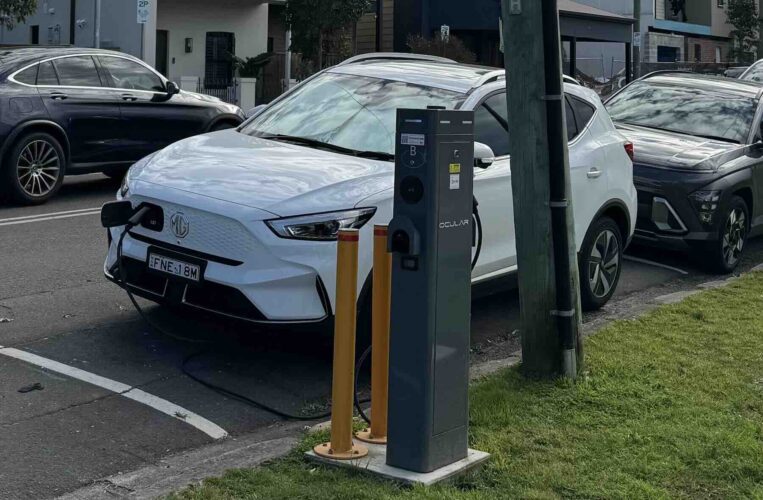
Australians are subsidising kerbside chargers whether they like it or not, but only one of these subsidies creates an incentive to buy an electric vehicle, says a senior executive at Australia’s biggest distributed network company.
Nick Black, the head of fleet and charger logistics at Ausgrid, says the New South Wales (NSW) government has kicked in up to 80 per cent of the cost of installing all 530 kerbside chargers in the company’s Sydney network.
A second scheme will see the federal government is about to cover up to another 30 per cent of installation costs via a new public charger fund.
But while taxpayer funding can boost charger numbers, only electricity distributors can also lower the cost of charging itself, Black says.
“Either [consumers are] investing through tax, or it’s paid for in the electricity bill, but at a lower rate because it’s scaled,” he told Renew Economy .
“It’s really about opening up that access and appreciating that … they’re being funded today so what’s the fairest way to fund a kerbside charger to create truly public infrastructure that lowers the cost to the consumer?”
Black is stepping into a debate about whether electricity distributors should be allowed to compete with the private sector to install electric vehicle (EV) chargers, and add a potentially lucrative new asset to the pool they earn revenue from.
It’s one that is reaching white-hot temperatures following a federal intervention that gives $33.3 million to electricity distributors to fill gaps in street charging infrastructure left by private companies, and forcing a change in energy market rules to allow them to do so.
Private charger companies, electricity consumer groups and some industry experts and lobbyists say it’s a land grab that will crowd out private companies , and that electricity distributors are the reason why private companies have struggled to gain a foothold.
With the federal win under their belt, electricity distributors are now trying to justify the significant departure from rules – and why they couldn’t enable the new industry within them.
The vision Ausgrid and other distributors are pitching is that they are best placed to bring down charging costs for all EV owners, even if all electricity consumers have to share the bill (estimated at just $1 per household per year by the market rule maker).
They argue that as more people will see EV chargers, they will be more confident to buy EVs, and that the increased use of the network will eventually mean lower power bills for consumers.
Black says an extra 400,000 electric vehicles on the Ausgrid network could lower power bills by as much as $12 a year.
He denies that Ausgrid has deliberately made it difficult for private companies to lease or access the city power poles it owns, and says they have worked within ring-fencing rules but so far it simply hasn’t delivered enough chargers for Sydney’s packed streets.
“We’ve been working a lot on creating critical peak tariffs that work for the market as well as specifically for EV charging operators,” Black says.
“In addition to that, we’ve been streamlining all our processes to ensure that charge point operators can apply for access to place their charging equipment on our power poles.
“That’s been quite successful with us already seeing over 530 kerbside chargers rolling out, but… it’s still not enough.
“We’ve tried with the tariffs, we’ve opened up the access, and then we still believe there’s more that needs to be done.”
Genuinely helpful?
But the idea that Ausgrid in particular and distributors in general have been genuinely trying to enable private sector charging infrastructure is met with skepticism by the industry.
Multiple sources have told Renew Economy that DNSPs in New South Wales (NSW) and Victoria in particular have made it very difficult to get permission to use poles for kerbside chargers, and expensive.
Even the energy rule maker is skeptical of distributor claims that they’ve been helpful.
A draft rule change, needed to make the federal charging plan possible, pointedly acknowledged barriers to entry including months-long connection timeframes and power pole access charges ranging between zero and $300,000 a pole.
Inside the rule change it suggested “a targeted and time-limited program” to encourage distributors to cooperate.
The federal ‘Accelerating EVCharging Program’ also sets a fixed $700 connection fee and caps pole leases at $250 a year for kerbside chargers.
Black would not reveal Ausgrid’s usual rates nor whether they are higher than the federal fees, saying each of the five charge point operators currently running the 530 chargers in its grid “negotiated an outcome… that works for their business model.”
Software neutral, hardware competition
Where electricity distributors could offer a real edge for EV owners is their open platform model, which is open to any charging retailer and covers the cost of being on the platform and the cost of power.
It will still compete with private companies wanting to install their own chargers on poles.
But Black says the software platform at least will be a “neutral host” and this is one way they will be able to offer cheaper charging for consumers. Companies such as Chargefox have already shifted away from owning hardware to being software-only, providing the app, billing and other services inside the charger.
“The proposed DNSP model is that we create competition at the socket… we open up access to any electricity retailer or e-mobility service provider to compete for the customer at each socket on the street,” he says.
“What the model is proposed to do is to extend home charging to the curb and create this open access model.”
Black says they could deliver similar rates to what Citipower is offering in its 100-charger trial in Melbourne of 20-24c/kilowatt-hour (kWh).
That’s a much better deal than the 50c/kWh peak rates currently offered by EVX, for example, in Sydney and Melbourne.
“So there’s competition at a charger level as opposed to an infrastructure level,” Black says.
“There’s not really any competition for customers who want to charge on the street because they’re locked into whoever that single provider is at that 55c/kWh.”
Black would not say how much of the ongoing infrastructure cost, currently included in the price paid at privately-owned chargers, will be passed on to Ausgrid bill payers.
The Australian Energy Market Commission (AEMC) suggested in its draft rule change the capital cost of installation might be in the realm of $1 per year extra on bills, but didn’t offer any insight into ongoing running costs.
But with battery electric cars out-selling petrol for the third month in a row in October and forecast to just keep going , more chargers are needed and consumers may need to swallow that cost.
The private sector says they shouldn’t swallow this forever as incremental charges on electricity bills.
But Black argues that if governments and consumers want kerbside chargers to appear faster, they have to accept network involvement.
To join more than 29,000 others and get the latest clean energy news delivered straight to your inbox, for free, click here to subscribe to our free daily newsletter .
To support independent media, and help combat the spread of deliberate misinformation and disinformation about the energy transition, you can click here to make a one off donation or become a regular supporter of Renew Economy.
Rachel Williamson is a science and business journalist, who focuses on climate change-related health and environmental issues.
Share on Facebook (Opens in new window) Facebook
Share on X (Opens in new window) X
Share on LinkedIn (Opens in new window) LinkedIn
Share on Reddit (Opens in new window) Reddit
Email a link to a friend (Opens in new window) Email
Print (Opens in new window) Print
AEMC , Ausgrid , DNSP , electric vehicle , EV charging
Host of giant PV and battery hybrid project wants to sell – and the solar lease is now the big sales pitch
A host of almost a third of the land of one of the country’s biggest solar and battery hybrid projects wants out, and institutions could be the buyer.
Australia missing big opportunity in battery manufacturing, despite having all the minerals
Australia is missing opportunity to create a thriving battery manufacturing industry because it exports critical minerals rather than turning them into high-value products.
Jennifer Dudley-Nicholson
Customers are already subsidising kerbside EV chargers, so why not through a network company, Ausgrid says
Australia’s biggest network operator defends industry’s move into kerbside EV charging, and denies it is the cause of barriers to private participation.
The Driven Podcast: Australia’s EV discount under threat as more Chinese EV brands arrive
Australia’s EV discount hangs in the balance, 300 streetlight EV chargers are set to be trialled in regional NSW, and more Chinese electric cars are heading our way. Plus, what we’ve been driving lately.
The Driven Podcast
Join our WhatsApp Channel
I allow to create an account
When you login first time using a Social Login button, we collect your account public profile information shared by Social Login provider, based on your privacy settings. We also get your email address to automatically create an account for you in our website. Once your account is created, you’ll be logged-in to this account.
Please login or register to comment
Plan to build big battery in ex-premier’s home town will have to dodge abandoned gold mine shafts
Coal power offers “no chance to compete,” says Rio Tinto, as smelters go all-in on renewables
“Deniers and delayers:” Bowen marks 600,000 cheaper home batteries, but says balcony solar cannot be rushed
State adds $4,000 “discount” to energy upgrade scheme, targeting low-income households and renters
“Unbankable:” Fresh blow to Beetaloo as last of Big Four banks rules out finance for new gas pipelines
The line that Australia’s nuclear power ban was never properly debated is, frankly, bullshit
Was Australia’s nuclear power ban rushed through parliament with little debate? A look at the political history shows it was acually quite the opposite.
After COP31 letdown, the worst thing Albanese can do now is to sound retreat on EVs, batteries and housing
Disappointment in Antalya comes as PM mulls reverse on key climate policies. But, just like the PM’s retreat on indigenous policies, it would be a generational error.
