
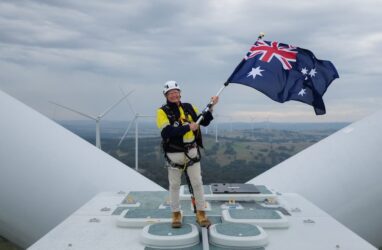
Andrew Forrest’s renewable and storage developer Squadron Energy has laid out plans to build what would be the biggest battery in Australia, a 1,000 MW facility with up to 8 hours of storage near Lithgow, west of Sydney.
Squadron, currently building the only wind farm under construction in New South Wales, at Uulunga, has filed a scoping report for the Cullen Bullen battery with the state’s planning authority, and hopes to plug it into an existing 500 kV transmission line in an area already dotted with big battery proposals.
The $1.5 billion project is still in its early stages, and Squadron says it is keen to engage with the local community in an area that is transitioning from the coal fired generation that once underpinned the local economy.
“We want to hear from local residents and businesses as we develop this proposal, understand what matters to them and identify opportunities for the project to benefit the wider community,” project director Sean Cross said in a statement on Tuesday.
“Squadron is committed to delivering real benefits for local families and businesses through investment in infrastructure, funding for community programs and the creation of local jobs and training opportunities.”
The Cullen Bullen battery would be located around 25 kms north of Lithgow, and 130 kms north-west of Sydney, on around 660 hectares of already cleared land (for grazing). Squadron hopes to begin construction in 2030.
It would be located right next to the Cullen Valley coal mine, and around 1.2 km from Alinta Energy’s proposed 500 MW Ben Bullen wind project near a village (166 people) of the same name.
The local area is already slated to host several wind projects, including Ben Cullen, Sunny Corner and Mount Lambie, and other big battery projects such as the Mt Piper, Wallerawang, Pinecrest, Great Western and Ivanhoe batteries, and the Mt Lyell pumped hydro storage project.
The Wallerawang coal fired power station has already been shuttered and the Mt Piper coal generator is due to close in the next decade. Several coal mines are still in operation, including the one next door to this project, with some seeking approvals for expansions and extensions.
Squadron says the battery project would provide voltage control and back-up power for the grid.
“The objective … is to provide storage and firming for the electricity grid,” the scoping report says. “The BESS would help manage grid stability and inertia by balancing the peaks and troughs of renewable energy generation, helping to integrate a greater share of renewable energy generation into the NEM (national electricity market).”
Squadron Energy says it is committed to entering into a voluntary VPA (voluntary planning agreement) with the Lithgow City Council, contributing to a total benefit sharing funding rate of $150 per MWh per annum as per the state’s Benefit-Sharing Guidelines.
“As part of Squadron Energy’s ongoing commitment to the local communities it works in, it is Squadron Energy’s intention for a proportion of this benefit to go directly to Cullen Bullen and the surrounding communities,” it says.
“We’re already investing in the local community through our sponsorship program, with funding available to support organisations delivering education and training, community development, health and wellbeing, and environmental initiatives,” Cross said.
The preferred technology is lithium ion phosphate, although it acknowledges the impending arrival of other chemistries, including sodium, flow and solid state, that can deliver benefits such as higher energy densities, faster charging times and enhanced safety.
“However, despite these advancements, lithium-ion batteries remain the most advanced and dependable technology available today,” the company says.
It is likely to use grid-forming inverters, enabling the battery it to contribute to the fault level in the network, stabilise voltage, and potentially provide synthetic inertia to stabilise frequency.
“While not big enough to singlehandedly replace a coal-fired generator, it could provide support in combination with other generators to address the shortfalls created by the transition away from coal generation,” the scoping report says.
The project area includes one residence owned by the landowner, but there are no other households within 2 kms of the project boundary.
The Cullen Bullen battery will be more than twice the size of the two biggest battery projects currently under development in Australia, the Supernode battery near Brisbane and the Eraring battery in NSW.
It will be nearly 70 times bigger – in storage capacity – than the original Tesla big battery at Hornsdale in South Australia, which was sized at 100 MW, and 129 MWh.
To support independent media, and help combat the spread of deliberate misinformation and disinformation about the energy transition, you can click here to make a one off donation or become a regular supporter of Renew Economy.
To join more than 29,000 others and get the latest clean energy news delivered straight to your inbox, for free, click here to subscribe to our free daily newsletter .
Giles Parkinson is founder and editor-in-chief of Renew Economy , and founder and editor of its EV-focused sister site The Driven . He is the co-host of the weekly Energy Insiders Podcast . Giles has been a journalist for more than 40 years and is a former deputy editor of the Australian Financial Review. You can find him on LinkedIn and on Twitter.
Share on Facebook (Opens in new window) Facebook
Share on X (Opens in new window) X
Share on LinkedIn (Opens in new window) LinkedIn
Share on Reddit (Opens in new window) Reddit
Email a link to a friend (Opens in new window) Email
Print (Opens in new window) Print
Strict new grid connection rules for data centres could provide inside running for big battery projects
Data centres will need to have fault ride-through and ultra-fast voltage control “active, modelled and compliant” before they can be energised.
Andrew Forrest’s Squadron Energy proposes Australia’s biggest battery – up to 8,000 MWh – west of Sydney
Andrew Forrest’s Squadron Energy unveils plans for Australia’s biggest battery – with nearly 70 times the storage of the original Tesla big battery.
Host of giant PV and battery hybrid project wants to sell – and the solar lease is now the big sales pitch
A host of almost a third of the land of one of the country’s biggest solar and battery hybrid projects wants out, and institutions could be the buyer.
Australia missing big opportunity in battery manufacturing, despite having all the minerals
Australia is missing opportunity to create a thriving battery manufacturing industry because it exports critical minerals rather than turning them into high-value products.
Jennifer Dudley-Nicholson
Join our WhatsApp Channel
I allow to create an account
When you login first time using a Social Login button, we collect your account public profile information shared by Social Login provider, based on your privacy settings. We also get your email address to automatically create an account for you in our website. Once your account is created, you’ll be logged-in to this account.
Please login or register to comment
Plan to build big battery in ex-premier’s home town will have to dodge abandoned gold mine shafts
Coal power offers “no chance to compete,” says Rio Tinto, as smelters go all-in on renewables
“Deniers and delayers:” Bowen marks 600,000 cheaper home batteries, but says balcony solar cannot be rushed
State adds $4,000 “discount” to energy upgrade scheme, targeting low-income households and renters
“Unbankable:” Fresh blow to Beetaloo as last of Big Four banks rules out finance for new gas pipelines
The Driven Podcast: Australia’s EV discount under threat as more Chinese EV brands arrive
The Driven Podcast
The line that Australia’s nuclear power ban was never properly debated is, frankly, bullshit
After COP31 letdown, the worst thing Albanese can do now is to sound retreat on EVs, batteries and housing
