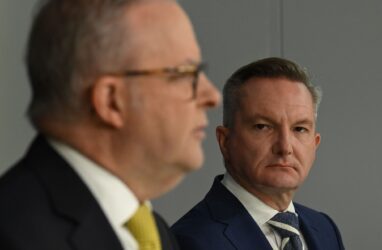
Right now, an exhausted and dejected Chris Bowen is winging his way back to Australia after failing to land a final “cover agreement” at the COP31 climate conference in Turkiye.
The opposition, both the political one and the fossil-fuel backed Murdoch media, are gleefully preparing a hostile reception.
Bowen must resign for being “personally responsible for this catastrophic diplomatic disaster” as president of the COP negotiations, thundered his shadow counterpart Dan Tehan on Monday.
Never mind that the lead blockers at Antalya included that arch foe of what counts as the West, Russia, which no amount of diplomacy would have budged. Saudi Arabia, which Bowen visited in September, was even more intransigent than is usual at these climate gatherings, insisting fossil fuels dodged the opprobrium they deserve.
Also, in Bowen’s defence, an inability to secure a consensus among almost 200 nations should come as of little surprise, given how fractured geopolitics is right now.
Ironically, we should take as a blessing a major source of that fracturing, the United States, led by an increasingly pro-Moscow president, Donald Trump, was absent from the climate conference.
Trump – whose elections to office were universally supported by Murdoch’s media outlets, lest we forget – had withdrawn the US from the Paris Climate Agreement a second time, removing one rogue element from Antalya.
The risk for Bowen – and climate action in general in Australia – is that the Albanese government will take the wrong cues from COP, and devote even less financial and political capital to issues that will only demand more of both in the not-so distant future.
A glance at the latest global surface air temperatures, setting a record even as the COP talks ended in disarray, should give every serious leader pause.
For this government, there is a precedent of sorts to watch out for.
On election night in May 2022, the soon-to-be-sworn-in Prime Minister Anthony Albanese committed his government “to the Uluru Statement from the heart in full”.
The rejection of “Voice to Parliament” referendum in October 2023, however, extinguished government interest in one of the Statement’s three components. The other two – a treaty and truth-telling – have since all but disappeared without a trace, replaced mostly by a focus on “economic empowerment” .
A battered Bowen will have to front a cabinet that seems all but certain to cave into media and analyst calls to cut “excess spending” in the wider economy by targeting two of its most popular policies: novated leasing for certain electric vehicles and the Cheaper Home Battery scheme.
Sure, both policies have had their flaws, not the least the absence of means-testing. Your correspondent is one of the beneficiaries of the leasing program, and would likely have purchased an EV even without the tax concessions.
Still, having more EVs in the second-hand car market will enable more people experience the quiet, smooth driving that avoids exhaust-pipe pollution and spares importing costly fossil fuels from volatile regions, (as the Grattan Institute highlighted in a report out on Monday that we covered here ). Most won’t go back to petrol.
The $8 billion battery subsidies have already ensured more than 600,000 homes have much larger storage than otherwise would have been the case. The electricity market operator, AEMO, has already flagged how large-scale batteries will give the grid a buffer this summer, and the 12-plus gigawatts of household batteries will help too.
Bowen can fortify his case for sustaining battery support by pointing to the avoided billions of dollars avoided on network infrastructure or similar savings in reduced wholesale power prices from burning less of the costly fossil gas in electricity generation.
The lower greenhouse gas emissions from both the EV and battery costs to the budget are a bonus that should be added to the plus column, but probably won’t be.
But it won’t just be EVs and battery programs that Bowen will face rollback efforts.
Renew Economy can reveal that the government is examining whether to water down the national housing energy standards, with a decision likely in the next week or so.
The Housing Industry Association and the Business Council of Australia are among those pressing to weaken the codes, and the Prime Minister is open to the move, we understand.
The Albanese government has been circling this victim for some time.
Indeed, one of the few outcomes from the “Economic Reform Roundtable” , held in the wake of the government’s 2025 election triumph, was to decide to “work with states and territories to pause further residential changes to the National Construction Code until the end of the National Housing Accord period (mid‑2029), following finalisation of NCC 2025″.
The so-called “modernisation” of the NCC, supposedly to reduce red-tape, has already released an interim report.
“The aim of the NCC Modernisation Project is not to unwind or dilute important standards, but to provide confidence and certainty around how buildings should be constructed through an easy-to-use NCC,” is how that interim report states the “context” as.
“The Australian Government remains committed to essential safety and quality changes, along with important policy settings, like the strong residential standards adopted in NCC 2022, including 7‑star energy efficiency.”
A spokesperson tells Renew Economy that “Treasury is finalising its final report to the government for the National Construction Code Modernisation Project,” and it will be “a decision for government” as to when they release it.
According to one person familiar with the process, the involvement of Treasury itself, rather than housing, energy or even climate change policy in driving the housing codes points to a reduced priority for the energy efficiency and comfort of the houses the government wants built.
Politicians, who have supported tighter construction codes, warn against taking backward steps.
Barbara Pocock, the Greens spokesperson for finance, housing and homelessness and senator for South Australia, said our homes were already “infamously energy inefficient”, by wealthy nation standards.
“In a housing, climate and cost of living crisis, we need to strengthen, not weaken, our building standards to mandate higher energy-efficiency, climate resilience, and a mandatory transition to net-zero,” Pocock said.
“In a recent Greens-led Senate housing inquiry hearing , which I chaired, I heard from renters whose homes were 35 degrees [Celsius] at 10pm.”
“This is such a hypocritical government,” Pocock added. “They’re actively weakening our climate protections at home while presiding over climate negotiations at COP31.”
Zali Steggall, one of the two Community Strong MPs, said she would be “extremely concerned if the Albanese government were considering watering down energy efficiency standards for new homes”.
“Modernising the National Construction Code should mean building better, safer, more energy-efficient and climate-resilient homes – not lowering standards to appease industry lobby groups,” Steggall said.
“Poorly insulated, inefficient homes mean higher energy bills, uncomfortable living conditions and more pressure on the electricity grid, especially in extreme weather,” she said.
Those arguments will be more than familiar to Bowen, of course.
The question is whether he has the stamina to remake the case to his cabinet colleagues – and is joined by enough supporters among them – to avoid copping a major domestic reverse on this return to go with the international one he’s just had to endure.
To support independent media, and help combat the spread of deliberate misinformation and disinformation about the energy transition, you can click here to make a one off donation or become a regular supporter of Renew Economy.
To join more than 29,000 others and get the latest clean energy news delivered straight to your inbox, for free, click here to subscribe to our free daily newsletter .
Peter Hannam is a veteran journalist whose work spans almost four decades and includes stints outside Australia, including time in China, Japan, Singapore and Mongolia. He has lately reported extensively on energy, climate and environmental issues in Australia, and also worked for the federal Climate Change Authority as a special media advisor.
Share on Facebook (Opens in new window) Facebook
Share on X (Opens in new window) X
Share on LinkedIn (Opens in new window) LinkedIn
Share on Reddit (Opens in new window) Reddit
Email a link to a friend (Opens in new window) Email
Print (Opens in new window) Print
State awards contract to build major new transmission link, from old coal to new energy
EnergyCo names the winner of the contract to build and operate the transmission line that will link state’s new energy heartland with its coastal industrial hubs.
Rooftop solar ban to continue as network races to replace new towers blown down by “once-in-2,000 year” storm
Ban on rooftop solar exports to continue as authorities seek answers as to how and why newly installed transmission towers collapsed in face of fierce storm.
Not reliable, not affordable: Report shows ageing coal plants boost blackout risk, push up prices
New analysis shows Australia’s ageing coal-fired power stations are raising the risk of blackouts and higher electricity prices and should be phased out.
Jennifer Dudley-Nicholson
After COP31 letdown, the worst thing Albanese can do now is to sound retreat on EVs, batteries and housing
Disappointment in Antalya comes as PM mulls reverse on key climate policies. But, just like the PM’s retreat on indigenous policies, it would be a generational error.
Join our WhatsApp Channel
I allow to create an account
When you login first time using a Social Login button, we collect your account public profile information shared by Social Login provider, based on your privacy settings. We also get your email address to automatically create an account for you in our website. Once your account is created, you’ll be logged-in to this account.
Please login or register to comment
Plan to build big battery in ex-premier’s home town will have to dodge abandoned gold mine shafts
Coal power offers “no chance to compete,” says Rio Tinto, as smelters go all-in on renewables
“Deniers and delayers:” Bowen marks 600,000 cheaper home batteries, but says balcony solar cannot be rushed
State adds $4,000 “discount” to energy upgrade scheme, targeting low-income households and renters
“Unbankable:” Fresh blow to Beetaloo as last of Big Four banks rules out finance for new gas pipelines
Energy Insiders Podcast: On the ground at COP31
IGCC’s Anna Hancock offers on-the-ground insight into what has – and hasn’t – been happening at COP31. Plus news of the week with David Leitch and Peter Hannam.
Energy Insiders Podcast
EVs are getting better – the real-world tests show it. Now we just need chargers to catch up
To me, EVs need to be able to do long journeys in roughly the same time as ICE cars. Evidence suggests they’re nearly there – given the right charging network.