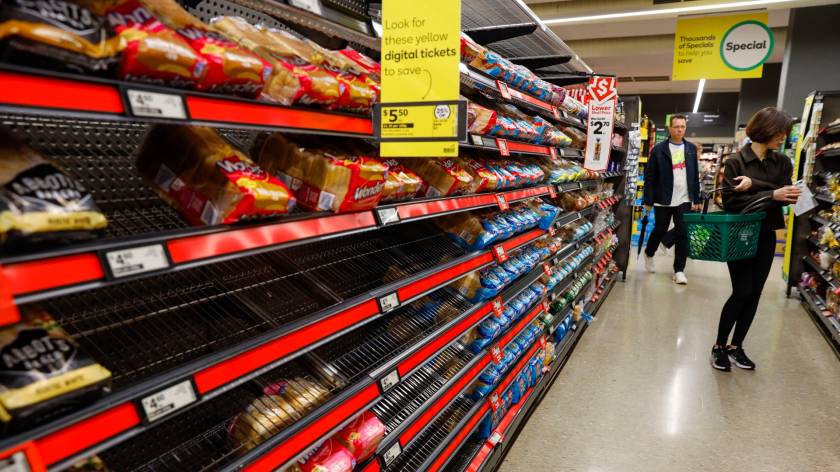
The federal government could buy hundreds of Coles and Woolworths stores and establish a publicly owned supermarket chain. That’s the vision under a $25.1 billion proposal welcomed by the Greens.
The plan, developed by Greens-aligned think tank the Green Institute, would establish a new government-owned chain called Fair Go Grocers, designed to compete directly with Coles and Woolworths and drive down grocery prices.
Related Article Block Placeholder Article ID: 342670
Fresh & Save expands again as family-owned grocer takes on supermarket giants
Greens leader David Shoebridge has welcomed the proposal, arguing rising grocery costs warrant considering new approaches to supermarket competition .
The proposal would involve the government acquiring 200 existing Coles and Woolworths stores and three distribution centres, before building a further 424 supermarkets and 10 distribution centres over five years.
The Green Institute wants the new chain to eventually capture about 20% of the grocery market, with stores operating at cost rather than generating profits for shareholders.
Smarter business news. Straight to your inbox.
For startup founders, small businesses and leaders. Build sharper instincts and better strategy by learning from Australia’s smartest business minds. Sign up for free.
By continuing, you agree to our Terms & Conditions and Privacy Policy .
It claims Fair Go Grocers could sell essential groceries, including fruit, vegetables, bread, milk and meat for 30% cheaper than Coles and Woolworths, while cutting the average grocery shop bill by 22%.
The institute estimates a family of four could save about $60 a week, or more than $3,100 a year.
Independent grocers push back
But independent grocers have pushed back against the proposal, arguing Australia should instead strengthen competition laws to give smaller supermarkets a better chance of competing with the major chains.
Master Grocers Australia chief executive Martin Stirling told SmartCompan y Australia did not need to repeat “failed 20th-century experiments in state-controlled food distribution”.
“This idea, which has been tried and tested by communist regimes, has been shown to lead to shortages, rationing, empty shelves and people standing in hours in queues, and is not the right way to distribute food across an economy,” Stirling said.
Stirling said it was “completely unnecessary” to spend $25 billion in taxpayer money establishing another supermarket chain.
Instead, the government should make it easier for independent operators such as IGA, FoodWorks, SPAR and Friendly Grocer to compete, invest and grow.
“There are thousands of independently owned and operated supermarkets around the country, many in regional and rural areas, and they are the best and most efficient way to provide excellent customer service, to provide consumer choice, and to put downward pressure on grocery prices,” Stirling said.
“It’s not necessary for the government to expand into grocery retailing. They need to create a competitive environment where independents can do what they do best, which is compete against majors and deliver for their communities.”
Related Article Block Placeholder Article ID: 181826
Tipping in: Why Ritchies supermarket boss Fred Harrison thinks all businesses should be forced to donate to charities
Stirling warned a new government-backed supermarket chain would itself put additional pressure on smaller operators already competing against Coles and Woolworths.
“This proposal doesn’t seem to contemplate independent supermarkets at all,” he said.
“Independent supermarkets at the moment are a minority in the economy.
“If the government were to assume a role in grocery retailing and become the major predominant retailer across the economy, that is going to impact independents.”
Getthing the competition laws right
The proposal comes amid continuing scrutiny of competition in Australia’s supermarket sector.
An Australian Competition and Consumer Commission (ACCC) inquiry found Coles and Woolworths together account for around two-thirds of national supermarket retail sales and concluded Australia’s supermarket sector was highly concentrated.
The Green Institute argues existing competition measures do not go far enough and says a publicly owned competitor would put direct downward pressure on prices.
But Stirling said the government should instead address barriers preventing existing independent supermarkets from expanding, including planning and zoning restrictions, access to suitable sites, and anti-competitive conduct.
“If the government gets the competition laws and settings and enforcement right, then that will ultimately lead to small businesses being able to meaningfully compete and put downward pressure on grocery prices, improve service, and give consumers that real choice that they can’t find elsewhere,” he said.
Stirling also argues the impact of independent supermarkets extends beyond competition with the major chains, particularly in regional communities.
“They don’t just provide groceries to their communities; they provide local employment, they support local producers like local farmers and manufacturers,” he said.
“They’re also deeply embedded within the community. They sponsor footy clubs and charities. It’s much more than just retailing groceries; it’s about the social fabric of the country.
The Fair Go Grocers proposal echoes a policy being rolled out in New York City under Mayor Zohran Mamdani, whose administration plans to establish five city-owned grocery stores, one in each NYC borough, with a core range of groceries priced 30% below typical retail prices.
The first of these New York stores is expected to open in 2027.
Never miss a story: sign up to SmartCompany’s free daily newsletter and find our best stories on LinkedIn .
Digital Business Journalist
Simon Thompson has worked across print, television and radio in Australia, the UK and the United States. His reporting has covered business and financial markets, immigration, politics and water policy. He previously covered UK and European private equity in London and has reported for NPR and PBS-affiliated outlets in the US. Simon studied journalism and politics at Monash University.
Recommended for you
“No silver bullet” for Coles, Woolies oligopoly in final ACCC report
Jacob Shteyman AND Andrew Brown Mar 21, 2025
$10 million fines, new record-keeping requirements for supermarkets in price gouging plan
David Adams Oct 21, 2025
Master Grocers Australia chief Martin Stirling appointed as new COSBOA chair
David Adams Nov 17, 2026