In an $800 billion-plus federal budget, $160 million is the equivalent of loose change down the back of the couch. *
Or if you’re the billionaire founder of Dial-a-Dump, the price tag on your 73-metre superyacht.
But when you have a $31 billion deficit, perhaps the Albanese government is counting every penny, which explains why it’s passing around the cap, asking state and territory leaders to chip in for a space mission some suggest will cost up to $160 million, to get the nation’s first astronaut wearing the Australian flag to the International Space Station.
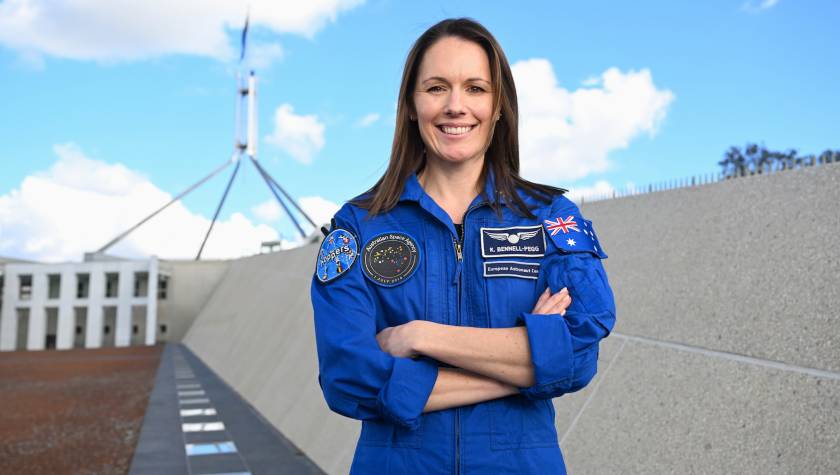
The Australian reports that ministers Tim Ayres and Andrew Charlton wrote to the premiers in August, chasing financial partners for Australia’s first official astronaut mission, by 2026 Australian of the Year, Katherine Bennell-Pegg , in early 2028.
The letter says the European Space Agency, where Bennell-Pegg trained, has invited Australia to participate, with a commitment required by mid-October.
But Canberra’s pitch had mixed response according to the Oz. South Australia, where she’s based, is keen. NSW has assumed its favourite position – sitting on its hands and wallet. But the Northern Territory’s Country Liberal Party lost it, with acting chief minister Gerard Maley calling the idea “reckless” and “way out of touch”, telling the government to “come back down to earth”.
Get the best of Startup Daily straight to your inbox
Want to know the latest in startup news? Subscribe to our daily news and analysis coverage on what’s happening to ANZ startups, investors and the broader ecosystem. And best of all, it’s FREE!
By continuing, you agree to our Terms & Conditions and Privacy Policy .
The Australian reports that the NT’s Department of Trade, Business and Asian Relations – no doubt awash with experts on space travel pricing – estimated the mission’s cost at between $120m and $160m.
Hopefully that figure’s more accurate than Maley’s understanding of space.
“The federal government cannot tell Australians there isn’t enough money for the things they need on the ground, then spend $160m going to the moon,” he chastised Canberra in his reply.
The ISS orbits about 400km above Earth. The moon is another 384,000km away.
But speaking of the Moon, NASA is sending an Australian-made lunar rover there ; and Australia tech startups such as Advanced Navigation are playing key roles in US projects heading back to Mr Squiggle’s home .
The begging letter from the federal ministers said the mission is “more than a seat for Ms Bennell-Pegg”, and would also carry Australian experiments and technology.
The project also has the support of industry and philanthropists such as pioneering tech entrepreneur and explorer Dick Smith, who pledged $1 million in April, arguing the mission would encourage children to pursue science, engineering and technology careers.
Bennell-Pegg graduated from the European Space Agency’s astronaut training program in April 2024, the first person to qualify as an astronaut under the Australian flag. She was selected from among more than 22,500 applicants.
Her earthly day job is director at the Australian Space Agency and an ambassador for STEM.
Long-term benefits
Swinburne space expert Dr Rebecca Allen says arguing about the price as some sort of the cozzie livs ignores the long-term economic and workforce benefits spaceflight has historically delivered.
She has a point if you look at the fact that Elon Musk has built a business now worth $3 trillion, SpaceX, in just 24 years and set to transform getting off this planet.
She points to the Apollo era and its breakthroughs in material science and life support technology
“At first glance, this seems exorbitant for a single person. But this is a long-term investment, think 20 years plus,” she said.
“By sending a single person to space now, the government is investing in Australia’s space sovereignty.”
Dr Allen agrees with Dick Smith about the potential of Bennell-Pegg’s historic mission to inspire future generations into STEM education and technical careers.
“She becomes a visible example that will allow students to see that Australia has a place alongside other nations in space and that their dreams are attainable,” she said.
“Instead of questioning if the government should invest in this flight, a better question is how it supports a national strategy to build real economic opportunities for our country.”
In the meantime, if you have any spare cash, ministers Ayres and Charlton would love to hear from you.
* We did the maths. $160m is 0.019632% of the government’s $815bn in annual revenue. For an Australian on average weekly earnings, it would be 41 cents a week – $21.30 for the year.
Simon has been editor of Startup Daily since 2019. He hosted the Startup Daily show on streaming service ausbiz.com.au from 2020 to 2023, and now, the weekly podcast Startup 360. He was previously associate editor of Business Insider Australia, a national restaurant critic, editor of The Good Food Guide, and newspaper proprietor during a 30-plus-years career in journalism and publishing. He’s also an investor in early stage startups.
Katherine Bennell-Pegg
Recommended for you
Astronaut Katherine Bennell-Pegg named 2026 Australian of the Year
Michelle Grattan Jan 26, 2026
South Australian Space Industry Centre names Campbell Pegg as its new director of space
Simon Thomsen Apr 29, 2025
You can now watch the Australian founder docos on Canva’s Mel Perkins, SafetyCulture’s Luke Anear, Finder’s Fred Schebesta & Brighte’s Katherine McConnell for free
Simon Thomsen Apr 15, 2025