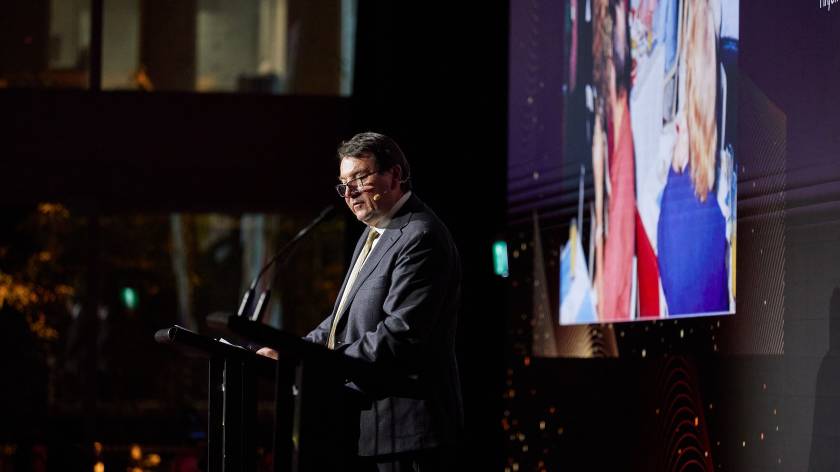
This is an edited version of Startup Daily editor Simon Thomsen’s address to the Best in Tech awards.
The Best in Tech awards celebrate people who look at the way things work and think: ‘there must be a better way to get this job done’.
That’s also what politicians, at their best, do.
Now I realise comparing you with politicians might test your goodwill, but please bear with me.
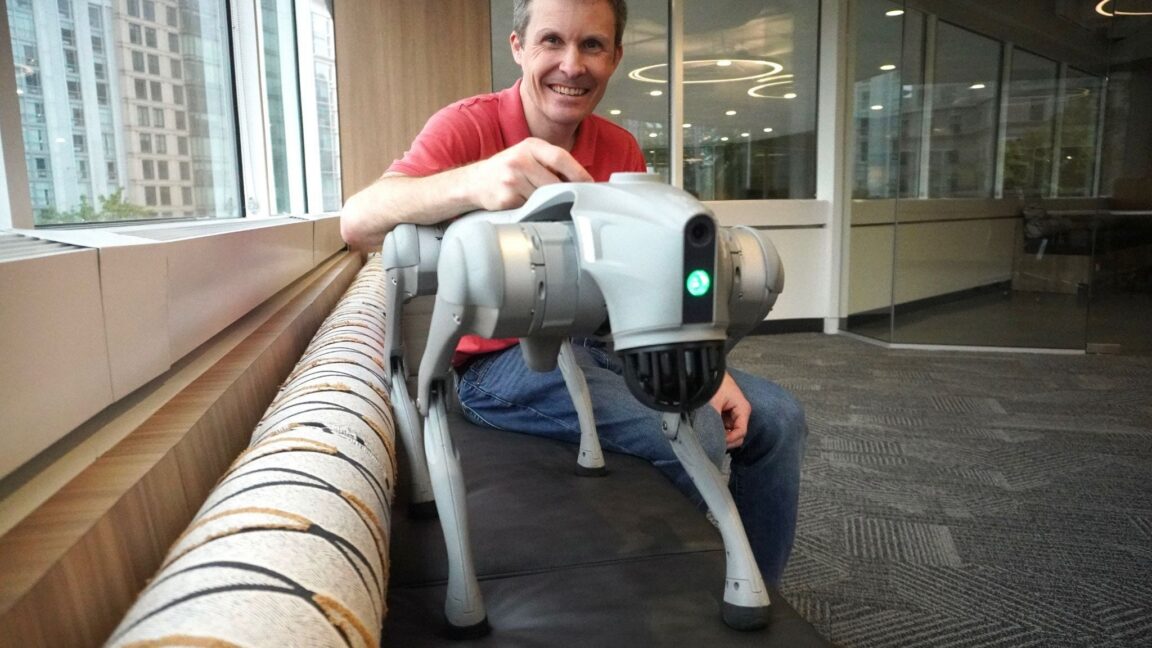
This photo ( below ) features a young man in a pink shirt (ie. me) at a pub called the Canberra, during the 1996 election campaign. The speaker is a former prime minister and one-time treasurer, shortly before the voters with baseball bats came for him.
Thirty years ago, I was a young founder, reporting politics, running a challenger media business and writing submissions to government inquiries on competition policy.
Get the best of Startup Daily straight to your inbox
Want to know the latest in startup news? Subscribe to our daily news and analysis coverage on what’s happening to ANZ startups, investors and the broader ecosystem. And best of all, it’s FREE!
By continuing, you agree to our Terms & Conditions and Privacy Policy .
Now I’m back doing it again in response to the federal Budget and its impact on the startup sector.
Capital gains tax, AI, R&D, skills. These aren’t abstract debates when you’re deciding whether to start a business, back a founder or join a startup.
Politics matters, but the eternal question is how much should we expect it to do? What problems should it solve?
Evan Thornley’s advice
Entrepreneur, philanthropist, impact investor and former Victorian MP Evan Thornley has a provocative answer.
Evan founded LookSmart in 1995, listing it on the Nasdaq and building our first internet-era unicorn. He even tried to buy Google – foolishly, Larry and Serge turned him down – then cofounded Getup and a decade ago, launched his 14th startup, LongView, to address the housing crisis.
Evan described himself “a serial recidivist offender” when it comes to being an entrepreneur. He also has, at age 62, stage 4 brain cancer. I want to send my best to him and his family.
On the Welcome to Day One podcast a few years back, Evan argued that bureaucracy is based on a 100-year-old theory, so it’s the “complete antithesis of a startup in every possible way”.
Get on with building if you’re a founder, he says.
He described government as “spectacularly irrelevant” to 99% of what startups do.
“We would all profit by wasting less breath on debating what governments ought to do to make us into an innovative economy. It’s a peculiarly Australian obsession… I just think it is a massive distraction,” he said.
There’s also funny aside in the conversation, where he talk about coming back to Australia after running LookSmart, and having made more money than he ever imagined. Evan quips that he had “a burning desire to fix the Australian Labor Party, which in retrospect was one of my more foolhardy aspirations”.
Engaging with politicians
But Evan has an important caveat on the role of government: tax rules matter.
Employees shouldn’t get a cash tax bill for share options when they haven’t received any cash.
A tax rule may be a line in a budget paper. For a founder, it can change whether the risk is worth taking, for employees, it’s deciding whether to leave a comfortable job and its perks for less money and a belief that sweat equity may be worth something.
But while you can’t wait for governments to help build your business, don’t confuse that with having no reason to engage.
Evan also says this isn’t about bad people. There are good hearts inside those institutions trying to improve the country.
That’s where founders and politicians have something in common.
Both begin with a problem they want to solve. Both must persuade people to back them. Both will discover how much they still have to learn. The pitch is the easy bit – making it work is the tough part to figure out.
Getting the idea to an MVP your customer or a voter will buy is a huge challenge.
So what happens if we approach a politician as a customer, rather than someone who’s supposed to make our lives easier. Instead, view that MP as someone whose needs we haven’t necessarily understood.
What problem are they trying to solve? Who do they answer to? How does our idea help the people they represent?
A founder can choose a target market. An MP still has to listen to the people outside it.
When we say “technology”, we might mean better healthcare, like Best in Tech finalist Heidi Health. But others hear fears such as market power, lost jobs, or worry about their kids.
We don’t have to defend everything big tech does to explain what our startups contribute.
A data centre might mean investment and capability to one person, and pressure on energy, water and amenity to another – and both perspectives deserve an thoughtful response.
You don’t build trust by calling the first view innovation and the second ignorance. Or by shitposting social media memes about MPs whose policies you disagree with.
Empathy isn’t agreement. It’s how you make disagreements more constructive.
Politicians as customer
So invite your MP into your business. Show them the problem you’re solving. Ask them about theirs. Make it a conversation, not just a request for more favourable tax treatment.
The next time I hear an MP speaking about great Australian innovations, I want them to tell a story about you, not something our nation did 60 years ago.
We need to show them people reinventing wheels now, rather than resting on the laurels of the last wheel that made someone a billionaire.
Governments can’t manufacture a great startup ecosystem. But they can help create the conditions for ideas to flourish, even if that does mean inaction. And it has to start with a conversation, rather than catastrophising.
These awards are a demonstration of what those ideas can become. Thank you for your inspiration.
What excites me most is your ambition with purpose: improving lives, opening opportunities and making Australia stronger. That ambition is, to borrow an old political phrase, a light on the hill.
Politics is about choices concerning the country we want to become. This room of people is a compelling, hope-filled answer.
Simon Thomsen is the creator of the Startup Daily Best in Tech awards and often votes below the line on Senate ballot papers.
Simon has been editor of Startup Daily since 2019. He hosted the Startup Daily show on streaming service ausbiz.com.au from 2020 to 2023, and now, the weekly podcast Startup 360. He was previously associate editor of Business Insider Australia, a national restaurant critic, editor of The Good Food Guide, and newspaper proprietor during a 30-plus-years career in journalism and publishing. He’s also an investor in early stage startups.
advice for founders
Recommended for you
Small by design: What Canberra’s innovation story teaches us about building in unlikely places
Hala Batainah Jul 10, 2026
Australian Built: we have the climate tech startups, now it’s time to let them grow
Mick Liubinskas Nov 9, 2026
Why Canberra software startup Aristotle Metadata went with venture debt for capital
Simon Thomsen Dec 22, 2025