
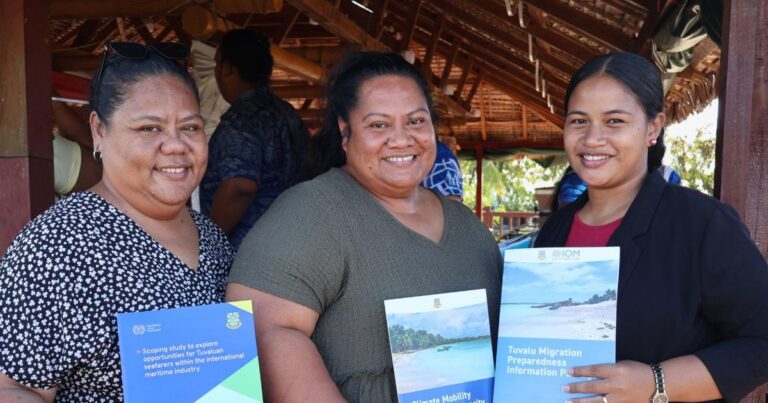
Officials from Tuvalu and New Zealand launch migration resources, Funafuti, May 2026 ( IOM )
A decade ago, the Government of Tuvalu, with support from the International Labour Organization (ILO), released the country’s first National Labour Migration Policy (NLMP). Its long-term vision was not large-scale migration, but to provide Tuvaluan citizens with increased opportunities for safe, managed temporary work and residence overseas.
The small central Pacific archipelagic state — with an estimated population of 9,420 in 2026 — is at the forefront of the climate change crisis . The country, which has a long history of labour migration, notably in phosphate mining (Nauru and Ocean Island) and seafaring in the decades before and after British Independence in 1978, seeks to retain self-determination and sovereignty in situ . In this context, migration is seen as an important component of climate adaptation efforts, helping to build Tuvalu’s climate resilience through enhanced access to education, skills, income diversification and alternative employment.


