
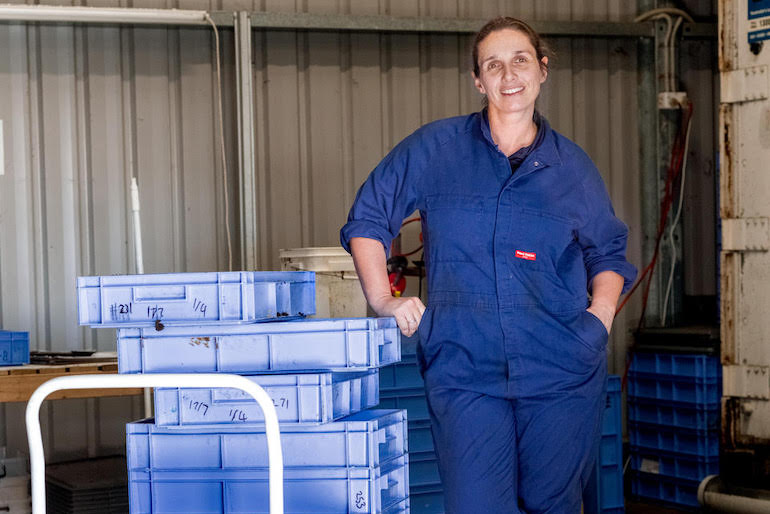
Goterra, one of Australia’s most recognised climate tech companies, entered voluntary administration earlier this month.
Led by award-winning founder Olympia Yarger , the company had real customers , real technology and real impact.
It had become a symbol of what Australian innovation can look like when robotics, biology, manufacturing and circular economy design come together.
Its collapse should alarm anyone who cares about the clean economy transition.
Goterra did not fail because the technology failed or because customers disappeared. It failed because Australia still has no investment architecture capable of carrying capital intensive technologies from early validation to commercial scale.
This is the Missing Middle, the long and lumpy capex intensive phase that every clean economy technology must pass through. And Goterra is not the first to fall into it.
Get the best of Startup Daily straight to your inbox
Want to know the latest in startup news? Subscribe to our daily news and analysis coverage on what’s happening to ANZ startups, investors and the broader ecosystem. And best of all, it’s FREE!
By continuing, you agree to our Terms & Conditions and Privacy Policy .
A female founder who cleared every hurdle still fell into the gap
I have held deep concerns about the structural under funding of female founders ever since entering funds management. It was one of the key motivators for leaving a 20-year academic career to found AxleTree Capital . The data is overwhelming.
Only 2% of Australian venture capital goes to all women founding teams, according to Cut Through Venture and Folklore VC.
Techboard shows only 10-15% goes to mixed gender teams. Swinburne University research shows women raise smaller rounds, at lower valuations, and must demonstrate more traction to secure the same capital as male peers.
The Equity Clear “Show Us the Data” report reinforces this picture.
It found that Australia has a funding gap that is visible, but a pipeline that is not. As the report states, “Australia can see who receives funding, but not where opportunities fall away.” And “the funding gap is visible. The pipeline is not.” Without pipeline visibility, “it is difficult to determine where drop off points occur or which interventions are most effective.”
Olympia Yarger cleared every one of the hurdles that female founders routinely face. She overcame the underfunding, the doubt, the lack of networks and introductions. She built a globally recognised technology, secured blue chip customers, proved the model and demonstrated real impact.
She made it through the early stage pipeline when so many women are knocked out before even getting a start.
But even that was not enough, because the Missing Middle applies equally and brutally to all capital intensive clean economy, hard tech and deep tech companies.
Once a technology needs tens or hundreds of millions to scale, Australia simply has no investment architecture to carry it forward. This is the phase where clean economy technologies must build factories, deploy infrastructure, and prove commercial scale. It is long, expensive and high stakes.
And Australia has no system designed to finance it.
Goterra was always going to hit that wall, and no one in the system did anything to stop it.
As Mick Liubinskas, co founder of Climate Salad, put it, “Australia doesn’t back ourselves.”
Goterra is the proof.
VC still can’t scale what matters
Side Stage Ventures released new data this week showing that Australia’s early stage VC ecosystem is booming. More funds, more deals, more founders, more activity. On the surface, this looks like success.
But it is the wrong kind of success if we care about building actual industries or delivering the clean economy transition.
Right now, Australia is building a thriving early stage ecosystem with no plan for what happens next. It is like building lots of kindergartens and primary schools, then expecting students to magically navigate their way from Prep to PhDs without any secondary schools, no teachers, no curriculum and no support.
Coming from education, I know what a real system looks like. Early childhood prepares you for primary school, which prepares you for secondary school, which prepares you for university or vocational training. It is not perfect, but it is linked. It is designed as a continuum.
Investment in Australia is not a continuum. We call it an ecosystem, but ecosystems only work when they are connected. If they are siloed and detached, it is not an ecosystem. It is an island. And right now, our early stage boom sits on an island with no bridge to the rest of the economy.
CGT debate distracts from the real problem
Recent commentary has claimed that Capital Gains Tax changes will kill innovation and drive founders offshore. But the innovations that matter most to Australia’s economic future in advanced manufacturing, agriculture, circularity, energy, waste and water are not being held back by CGT settings.
They are being held back by the absence of a financing system capable of carrying capital intensive technologies from pilot to platform to scale. Without the ability to scale, CGT is irrelevant.
As my colleague Matt Williams wrote in StartUp Daily, “Australia’s problem isn’t innovation. It’s the investment architecture for the Missing Middle.”
He is right. We have the ideas, the founders, the research and the customers. What we do not have is the capital system that connects them.
Ambitious Australia report confirms it
The Ambitious Australia: Strategic Examination of R,D&I report describes Australia’s research and innovation system as “atomised”, “risk averse” and “structurally incapable of turning promising technologies into globally competitive industries.” Without reform, the panel warns, Australia risks long term economic decline not because we lack innovation, but because we lack the architecture to scale it.
Goterra is the case study. A company with proven technology and real customers, but no pathway to scale.
Why super alone can’t fix this
Australia’s $4 trillion superannuation system should be a strategic advantage.
But the current Your Future, Your Super performance test benchmarks funds against indices that are “1.7 to 1.8 times more carbon intensive” than climate aligned alternatives. Funds that want to decarbonise are penalised for doing so.
ASFA has argued that a modernised performance test would “unlock better returns and drive productive investment.”
Treasury’s current consultation acknowledges that the performance test is now “one of the most powerful economic levers in the country” and that it is shaping capital flows in ways misaligned with long term value.
But super funds cannot fill the Missing Middle. Their fiduciary duties, liquidity requirements and tracking error constraints make it impossible for them to take early, lumpy, technology specific exposure.
Expecting them to invest earlier misunderstands their mandate.
The Cassandra curse of capital
At AxleTree Capital, our New Industries Fund was designed specifically to bridge the Missing Middle and carry proven, capital intensive technologies from validation to scale. But because our first of a kind fund is still raising capital itself, we could not support Goterra. The frustration was palpable.
I have often joked that we should have called ourselves Cassandra Capital, after the Trojan princess cursed to see the future but never be believed. But this is not a mythical curse. It is an investment sector choice.
Unless Australia reforms its investment architecture now, Goterra will not be the last. It will be the first of many.
The lesson from Goterra
Goterra’s collapse is not a story about entrepreneurial failure, and certainly not about a female founder who could not execute. It is a story about system design.
It shows what happens when a country with world class research, world class superannuation and world class climate ambition fails to build the investment architecture that connects them.
If Australia continues to ignore the Missing Middle, we will keep losing the very companies and the very founders we need to build a resilient, low carbon, competitive economy.
The question now is whether we are willing to learn from Goterra’s story and build the system that ensures the next generation of cleantech companies can survive long enough to scale.
Kate Gaffney is the cofounder of AxleTree Capital
Kate Gaffney is cofounder of AxleTree Capital and Director of Partnerships, Engagement and Research, where her role includes developing the early‑stage pipeline for AxleTree’s whole‑of‑lifecycle New Industries Fund. She is an Investor in Residence at the Wade Institute of Entrepreneurship and the former national chair of the Clean Energy Council’s University and Industry Working Group. Before entering funds management, Kate spent more than 20 years as a university academic researching regulatory failure and system design across child welfare and juvenile justice.
Recommended for you
Creditors vote to put food waste startup Goterra in liquidation
Simon Thomsen Jul 10, 2026
Goterra’s maggot ‘robots’ launch in Western Sydney, set to revolutionise food waste management
Startup Daily Nov 27, 2024
‘There’s no such thing as the right investor’: Goterra’s Olympia Yarger on why she turned to crowdfunding for her new raise
Olympia Yarger Nov 11, 2025