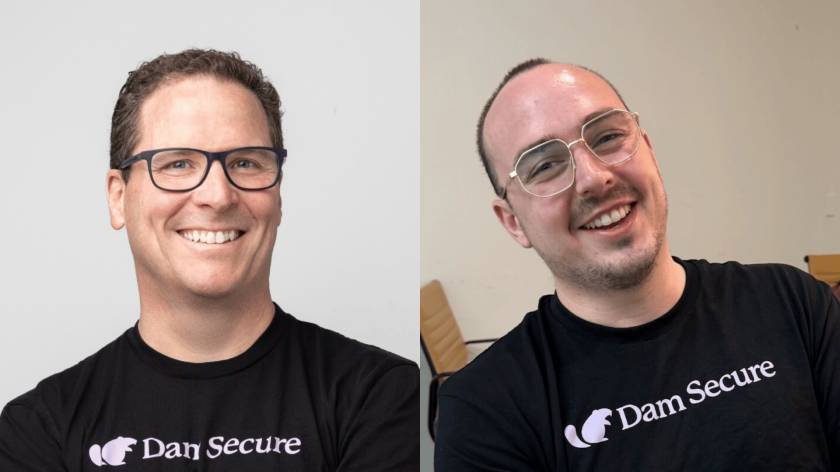
AI security startup Dam Secure has raised $6.1 million in seed funding to tackle the security risks created by AI-generated code entering production at scale, with the round led by Washington DC-based cybersecurity and AI investor Paladin Capital Group.
The oversubscribed round also attracted backing from Secure Code Warrior CEO Pieter Danhieux, RecordPoint CEO Anthony Woodward, Innovation Bay founder Phaedon Stough and Tyro Payments chief product officer Steen Andersson. Paladin Capital managing director Mourad Yesayan will join the company’s board.
The raise comes as enterprises rapidly roll out AI coding assistants, accelerating software output while introducing new classes of security risk that existing tools struggle to catch.
Founded by former Zip Co and Secure Code Warrior executives Patrick Collins and Simon Harloff, Dam Secure is building an AI-native application security platform designed to catch “logic gaps” in code. These are logic flaws where code functions correctly but fails basic security expectations, which Dam Secure says traditional code scanners often miss.
Collins, who is also the company’s CEO, told SmartCompany exclusively that enterprises are “rushing to adopt AI to increase developer velocity”, but existing application security tools are struggling to keep pace.
Smarter business news. Straight to your inbox.
For startup founders, small businesses and leaders. Build sharper instincts and better strategy by learning from Australia’s smartest business minds. Sign up for free.
By continuing, you agree to our Terms & Conditions and Privacy Policy .
“Existing security tools generate too much noise to work effectively in this new environment,” he said.
The company argues that while AI-generated code often works as intended, it frequently violates internal security policies or basic best practices because generic language models lack awareness of an organisation’s specific security requirements.
Rather than relying on pattern-based scanning for known vulnerabilities, Dam Secure allows organisations to define security requirements in plain English and automatically enforces those rules across large codebases during development.
The company positions itself as complementary to existing application security tooling, focusing on logic-level flaws rather than known vulnerability signatures.
For example, Collins pointed to a logic flaw disclosed in Volkswagen’s connected car APIs in May 2025, where the absence of rate limiting on a four-digit access code enabled brute-force attacks and exposure of vehicle location data.
“Dam Secure would have simply prevented this by automatically enforcing the logical rule: ‘All authentication endpoints must implement rate limiting’,” Collins said.
Under the hood, the platform builds what the company calls a proprietary Security Knowledge Graph for each codebase, mapping relationships, data flows and logic paths across the entire system. This allows the platform to reason about how code behaves in context, rather than scanning individual files in isolation.
“When you define a security rule in plain English, like ‘customer data must be encrypted at rest’, our agents can query this Security Knowledge Graph to find where this needs to be applied quickly, to understand the context and determine if there is a security flaw,” Collins said.
The platform currently supports Java, C#, TypeScript, JavaScript, Python and Go, and acts as a security wrapper around AI coding tools such as GitHub Copilot, Claude and Cursor, regardless of the underlying language model used.
Dam Secure is currently deployed with six major technology organisations on a private, invite-only basis, running alongside existing application security tools rather than replacing them.
Collins said early results show false positives below 10%, compared with industry averages of around 50%, by catching logic errors earlier in the development lifecycle.
One customer, he said, has seen Dam Secure repeatedly catch the same rule violations in AI-generated code even after multiple regeneration attempts, preventing flawed logic from reaching production and reducing remediation effort for engineering teams.
The funding will be used to grow Dam Secure’s Australian R&D team to 13 people and build a US-based sales and marketing presence, as the company prepares for a broader commercial rollout through 2026.
Never miss a story: sign up to SmartCompany’s free daily newsletter and find our best stories on LinkedIn .
A multi-award-winning journalist, Tegan has been reporting on technology, telecommunications and gaming for the past 10 years. She regularly appears on mainstream media channels as an expert tech commentator. Her previous roles include editor of Gizmodo Australia and global reviews editor at Finder. She has also served as a reporter and editor across Business Insider, Lifehacker and Kotaku Australia. Tegan is also the co-host of one of the top technology podcasts in Australia, Weird Tech. You can find her on Twitter @Tegan_Writes.
Recommended for you
Four ANZ startups that raised $307.1 million this week
Tegan Jones AND Simon Thomsen Jan 23, 2026
Two Aussie startups that raised $12.7 million this week
Eloise Keating Jun 20, 2025
Three ANZ startups that raised $25.1 million this week
David Adams AND Simon Thomsen Oct 23, 2026