
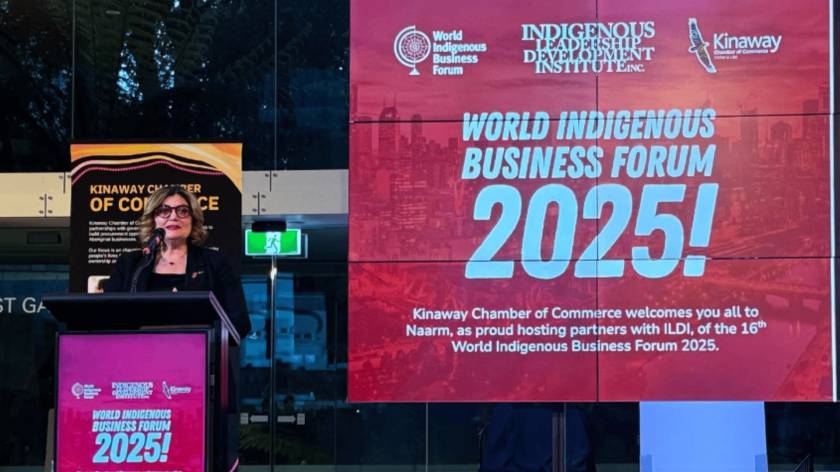
The 16th annual World Indigenous Business Forum (WIBF) 2025, held last month in Naarm (Melbourne), served as a powerful declaration that First Nations leadership is intent on transforming global commerce.
Hosted from October 28-30 at the Hyatt Place Melbourne Essendon Fields by the Kinaway Chamber of Commerce and the Indigenous Leadership Development Institute, the forum marked its first return to Australia since 2012.
The message at the forum was clear: this is not business as usual. This is commerce powered by cultural value, reciprocity, and self-determination, not just profit. First Nations leaders from all over the world lined up to demonstrate that with Indigenous values at the heart of business, economic success can be achieved without harm to people and planet.
Global partnerships for a flourishing world
The forum showcased international partnerships that explicitly reject traditional extractive models in favour of a sustainable, values-driven standard.
50/50 fisheries ownership (Canada)
A groundbreaking case study in resource management was the C$1 billion acquisition of Clearwater Seafoods by a coalition of Mi’kmaq First Nations, establishing a 50/50 ownership structure with Premium Brands Holdings Corporation. This deal positions Indigenous governance at the heart of the sector, ensuring long-term sustainability for the fisheries while using revenues to fund critical community self-sufficiency initiatives.
Regenerative luxury (hospitality)
The concept of non-harm was applied to high-end tourism with models like that of VIRTU Resort & Residences Ltd, which champions “regenerative luxury”. CEO of VIRTU Sandi Lesueur spoke about the company’s aims for a net-positive cultural and environmental impact. VIRTU mandates collaboration with Indigenous partners to integrate their ecological wisdom into operations, ensuring operations do not harm the land while achieving financial success.
Smarter business news. Straight to your inbox.
For startup founders, small businesses and leaders. Build sharper instincts and better strategy by learning from Australia’s smartest business minds. Sign up for free.
By continuing, you agree to our Terms & Conditions and Privacy Policy .
Defining commerce: The IPETCA Framework
Discussions at the forum underscored the global push to codify a new ethical standard into formal international agreements, as seen with the Indigenous Peoples Economic and Trade Cooperation Arrangement (IPETCA).
Related Article Block Placeholder Article ID: 315771
Bush to bestseller: Small businesses are leading Australia’s native botanicals export boom
The IPETCA is the first modern, comprehensive international Indigenous trade arrangement, and its definition of trade fundamentally changes the rulebook. It mandates that trade must be relational and aim to build long-term networks.
IPETCA requires adherence to core Indigenous values, including reciprocity, care, trust, respect, and generosity. Crucially, it must operate within an intergenerational framework and uphold the responsibility to protect lands and resources.
The IPETCA was initiated by New Zealand. Its founding member economies include Australia, Canada, New Zealand, and Chinese Taipei.
The conference featured two distinct panels addressing this new global landscape, including one on international trade challenges and opportunities, which was moderated by Wayne Garnons-Williams, a key figure in IPETCA’s development.
The second panel, titled When First Nations Trade, provided specific Australian strategies, with Professor Kerry Arabena arguing for embedding cultural integrity into global export strategies alongside Brian Bero from Indigenous Business Australia (IBA), who focused on the investment needed to scale Indigenous enterprise.
Australian innovators: Cultural governance in retail and finance
The WIBF showcased how Australian Indigenous businesses are leading the transition, supported by key institutional players.
IBA was present as a key partner, highlighting its role in promoting Aboriginal and Torres Strait Islander self-management and economic self-sufficiency. Its mandate focuses on advancing social and cultural development alongside commercial interests through its programs in home ownership, business solutions, and investment. IBA’s impact is significant: its Home Ownership Program has helped more than 22,000 Indigenous families and individuals to buy their homes, approving over $4 billion in home loans.
Related Article Block Placeholder Article ID: 326384
The hidden productivity revolution brewing in Australian social enterprises
Meanwhile, the sector’s ethical drive of the retail sector was demonstrated by:
Aboriginal Retail Australia (ARA): This new, national, Aboriginal-led body (launched 2025) advocates for fairer supply chain access, challenging tokenism, and ensuring that authenticity and profitability go hand-in-hand in mainstream markets.
Clothing The Gaps: The social enterprise, co-owned by Laura Thompson, uses its popular fashion line to fund the Clothing The Gaps Foundation and drive social change.
Chocolate On Purpose: Founder Fiona Harrison (Wiradjuri) demonstrated her enterprise model, which uses bush food-infused chocolate as a vehicle for cultural storytelling and reclaiming Indigenous women’s leadership in the native food supply chain.
Keynote focus: From paternalism to partnership
Dr Ernesto Sirolli, founder and CEO of Sirolli Institute and Author of Ripples from the Zambezi , delivered the keynote, The Third Way: From Paternalism to Partnership. His core message, “Want to help someone? Shut up and listen!”, was pivotal, stressing that true economic support requires respecting and enabling the community’s vision and self-determination.
The forum concluded with rapper Adam Briggs challenging attendees to “Defy Aspirations for Mediocrity”, urging ambitious, ethical excellence.
As businesses like those showcased at the WIBF continue to grow, it’s hard to imagine communities they touch not demanding other businesses adopt their more holistic benchmarks for success, beyond profit.
For Australian SMEs, securing prosperity in the future could mean moving beyond symbolic gestures and genuinely integrating the principles of reciprocity and self-determination at the core of how they do business. Certainly, if this values-based framework becomes the new measure of accountability, it’s sure to influence which businesses society deems fit to participate in the economy of tomorrow.
Kane Jackson is the co-founder of fintech Maslow .
Recommended for you
26. First Nations Foundation
SmartCompany Nov 14, 2024
Australia Post urged to allow competitors to deliver parcels in the regions
Stephanie Gardiner Oct 1, 2026
NSW startup Cauldron wins entry to World Economic Forum tech pioneer cohort
David Adams Jun 24, 2025
