Should you use other people’s?
Here’s why it’s probably best not to make a habit of it.
Microbes can stay active for a while
Many disease-causing bacteria, viruses or fungi live on cloth, plastic and metal objects in your bathroom. These so-called pathogenic microbes can remain viable on these surfaces for extended periods. That is, they’re able to cause infection for days, months or years.
For example , the fungus Aspergillus can remain viable for more than a month on cloth and plastic. Some bacteria can survive on these surfaces for years. And many viruses can remain viable for hours to months on some materials such as ceramics, metals, cloth and plastics.
But what is the risk from particular items such as used towels, razors and toothbrushes?
Get the best of Startup Daily straight to your inbox
Want to know the latest in startup news? Subscribe to our daily news and analysis coverage on what’s happening to ANZ startups, investors and the broader ecosystem. And best of all, it’s FREE!
By continuing, you agree to our Terms & Conditions and Privacy Policy .
Scientists haven’t run randomised controlled trials (the gold standard study design) to determine the risk. This would be when one group in a study is chosen at random to, say, shave their legs with someone’s used razor, and the infection rates of known pathogens compared with those randomised to a control group who didn’t.
But there are other studies that give us some clues.
Can I share towels? If you play footy, maybe not
Less robust studies suggest an increased risk of picking up a skin infection from used towels.
One report from the United States was of an outbreak of antibiotic resistant Staphylococcus aureas (or Staph, for short) in a group of high-school football players. Players who shared a towel were eight times more likely to pick up an infection.
Staph can cause the skin condition impetigo . But in rare cases it can lead to life-threatening septic shock and organs failing .
In this case, the risk of transmitting Staph was probably elevated due to potential cuts and grazes from playing a contact sport.
Another study , also from the US, followed 150 households for 12 months. Each household had a single child infected with Staph.
When household members shared towels, the risk of Staph transmission increased significantly.
You might think that microbes are washed off in the shower. While washing with soap and water reduces the number of microbes on the skin it does not completely eliminate them . And the warm, moist conditions of the average bathroom encourage microbial growth .
Even if you don’t develop an infection, becoming colonised by pathogens (when there is no damage) can be problematic.
That’s because you may be exposed to antibiotic resistant species, increasing the risk of developing antibiotic resistant infections later . These are more time consuming and expensive to treat.
How about a toothbrush? Think of the viruses
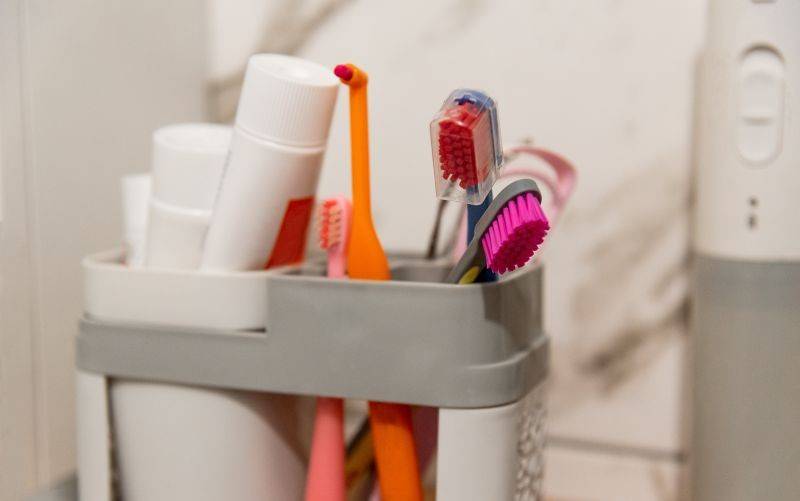
Microbes can remain viable on hard objects , such as toothbrushes. And toothbrushes can cause gums to bleed. So sharing them is discouraged as this can transmit blood-borne viruses such as hepatitis C .
Not everyone who is in a risk category for hepatitis C infection has been tested . And people can be infectious without having symptoms.
Anything that has come into contact with saliva (such as your toothbrush) may also transmit pathogens. These include herpes simplex virus type 1 (HSV-1), which causes cold sores , and Epstein-Barr virus , which causes glandular fever.
A person with no signs of HSV-1 infection can still shed viruses and cause infection .
One review found toothbrushes were contaminated with potentially pathogenic species of bacteria such as Staph, E. coli and Pseudomonas . HSV-1 was also found in sufficient numbers to cause infection. This virus can remain viable for two to six days on plastic objects.
Surely a razor’s OK? Not if you hate warts
Microbes can remain viable on hard objects such as razors too. And it’s hard to avoid nicks when using a razor. So there’s a risk of transmitting blood-borne viruses if you share.
Razors, towels and other personal hygiene items can also spread human papillomaviruses that cause warts. So it’s no wonder dermatologists recommend each person has their own items.
If you have cuts or grazes, this provides a portal of entry for microbes, putting you at increased risk of infection. Remember those footy players who shared towels.
Reduced immune function also increases the risk of infection. We see this in:
babies , whose immune system is still developing
elderly people , whose immune function declines in later life
people taking immune suppressing medications , such as cancer drugs, oral corticosteroids and drugs taken after an organ transplant
people with type 2 diabetes , because increased blood glucose levels damage the function of immune cells and associated molecules.
However, the overall risk of contracting an infection is low on any one occasion. And if you’re sharing a towel, razor or toothbrush with a partner, you’ll be in regular close contact and sharing microbes anyway.
But it’s still a good idea to avoid making a habit of sharing other people’s used bathroom items.
Thea van de Mortel , Professor Emerita, Nursing, School of Nursing and Midwifery, Griffith University
Thea van de Mortel
Professor Emerita (Dr) Thea van de Mortel is a registered nurse with a clinical background in intensive care nursing, a strong interest in the biosciences, an Honours degree in Biology and a PhD in infection control. She has combined these areas of expertise to teach and research in the areas of microbiology, pathophysiology and infection prevention and control across three universities. She taught into the Griffith University, Master of Infection Prevention and Control graduate program.
Recommended for you
A textile scientist explains why your washing gets smelly when it stays wet and how to fix it
Dr Saniyat Islam Sep 25, 2026
Regional biomanufacturer Cauldron brews up $19 million Series A2
Simon Thomsen Mar 25, 2026
Viral infections biotech ENA Respiratory inhales $3 million from government fund
Simon Thomsen Sep 4, 2026