
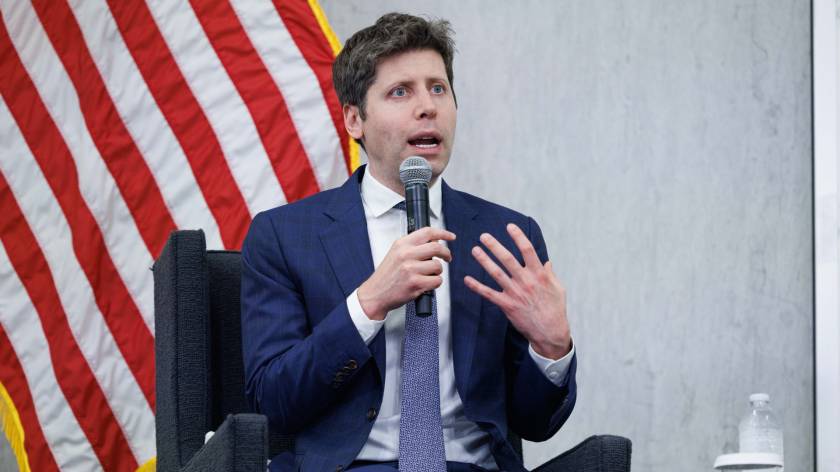
Artificial intelligence has “fully defeated” voice authentication as a form of identity check, claims OpenAI CEO Sam Altman, as Australian institutions stand by the technology they say is safe and secure.
Voiceprint systems compare a user’s voice against a pre-recorded sample, making it easier for customers to access bank accounts and services on the telephone without entering a PIN or answering security questions.
Speaking at a US Federal Reserve event on Tuesday local time, Altman said the prospect of realistic AI-generated voices penetrating voiceprint security checks made him “very nervous”.
“A thing that terrifies me is apparently there are still some financial institutions that will accept the voiceprint as authentication,” Altman said.
Using those systems as a barrier between callers and bank accounts is “a crazy thing to still be doing,” he said.
Smarter business news. Straight to your inbox.
For startup founders, small businesses and leaders. Build sharper instincts and better strategy by learning from Australia’s smartest business minds. Sign up for free.
By continuing, you agree to our Terms & Conditions and Privacy Policy .
AI has fully defeated that.
Advancing AI voice generation tools could cause a “significant impending fraud crisis,” he added.
OpenAI offers text-to-speech models, but the AI firm does not allow users to generate voices based on the audio samples of real people.
“We have tried, I think other people have tried to sort of warn people, to be like, ‘Hey, just because we’re not releasing the technology, doesn’t mean it doesn’t exist,’” he said.
Institutions, banks using protective system
Despite those concerns, many Australian institutions advocate for voiceprint systems as a barrier between scammers and sensitive information and financial details.
Optional voiceprint systems are used by Services Australia, the Australian Taxation Office (ATO), and a number of banks, including ANZ and Bank Australia.
Services Australia likens each person’s voice to a fingerprint, with a unique “sound, rhythm and pattern”.
“It’s very difficult for someone to access your personal information” through the voiceprint system, according to Service Australia.
“The system can tell when someone is pretending to be you or using a recording of your voice.
“We won’t give them access to your details.”
Related Article Block Placeholder Article ID: 297290
AI adoption and cybersecurity risks key issues at SmallBiz Week
That system faced scrutiny in 2023 when Guardian Australia reported one of its own journalists accessed their Centrelink account using an AI-generated clone of their voice and a customer reference number.
In a statement provided to Guardian Australia, a Services Australia spokesperson called the system “highly secure” and that the organisation makes “ongoing enhancements to ensure customer security”.
Other institutions stand by the safety and efficacy of the voiceprint system.
The ATO’s voice authentication system “is both a reliable and secure way of confirming your identity,” according to the tax office website.
It is capable of determining if the caller has aged, is in an “altered emotional state”, or has a cold affecting their voice.
“These, and other additional security elements of voice authentication, make it very difficult for someone else to mimic your voiceprint and access your personal information.”
ANZ says its voiceprint system, which can verify users before making high-value payments in the ANZ app, is a “safe and easy method of verifying your identity”.
The use of voice scanning technology has broader regulatory support, with the banking watchdog saying it was appropriate for use in multi-factor authentication.
“Retinal scans, hand scans, voice scans or other biometrics” are effective when partnered with passwords, PINs, security tokens, or authenticator apps, according to a 2023 letter sent to organisations regulated by the Australian Prudential Regulatory Authority.
Security reforms underway
Beyond voiceprints, Australia’s banking system has undergone a significant security overhaul over the past two years through a $100 million industry-wide security accord.
Central to that accord is a confirmation of payee system , making it easier for individuals and businesses to check if payment details match those of the intended recipient.
The agreement also calls on all major banks to take at least one form of biometric data for new customers opening an online account.
“These checks will be either detectable to a person’s behaviour or involve a check of a customer’s face or fingerprint, enabling banks to use these characteristics to verify their customer’s identity,” according to the Australian Banking Association.
Speaking at the US Federal Reserve event, Altman said generative AI poses security threats beyond voice emulation.
“All of these fancy ‘take a selfie and wave’” systems are similarly vulnerable, he said.
Videos and video calls will soon be “indistinguishable from reality”, Altman added.
Never miss a story: sign up to SmartCompany’s free daily newsletter and find our best stories on LinkedIn .
Senior Business Journalist
Focused on the small business sector, David’s work covers the political, regulatory, and economic issues facing Australian entrepreneurs. Prior to joining SmartCompany, he was a reporter for Business Insider Australia. You can follow him on LinkedIn.
artificial intelligence
Recommended for you
“Dangerous product”: Florida sues ChatGPT-maker OpenAI and CEO Sam Altman
David Fischer Jun 2, 2026
“Didn’t read the fine print”: Inside the Elon Musk vs OpenAI trial
Sam Altman slams Anthropic’s “dishonest” Super Bowl ads about ChatGPT
David Adams Feb 5, 2026
